The Preston Model and the future of the Community Wealth Building movement
May 8, 2026
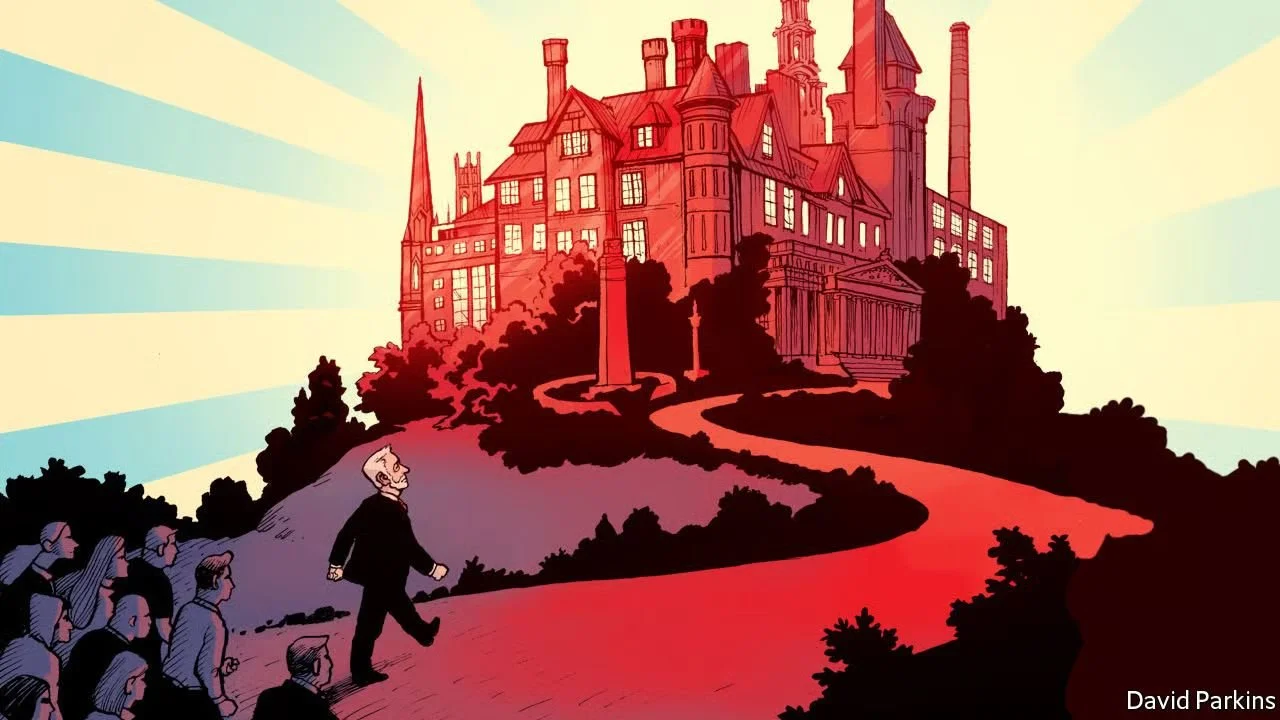
The Economist magazine dubbed Preston “Jeremy Corbyn’s model town”
With the May 7 local election results in, Preston City Council moves to No Overall Control, raising questions as to the immediate future of the Preston Model of Community Wealth Building. But no matter what happens next politically, Preston raised a banner that attracted attention and provided inspiration all around the world.
Political tides ebb and flow, often leaving little that is lasting behind. An exception is the Preston Model of Community Wealth Building, which has already made an outsized contribution to the world of political-economic transformative change – no matter what happens next in the corridors of Preston City Council.
At The Democracy Collaborative, we are partisans for Community Wealth Building, not for political parties. But it is important to be clear that the Preston Model is a success story. It was introduced in 2013 during a period of deep austerity, and demonstrated how a small local District Council, with other anchor institutions, working together with intent, could genuinely reshape a locality and build toward a more democratic economy.
“The Preston Model is a success story. It was introduced in 2013 during a period of deep austerity, and demonstrated how a small local District Council, with other anchor institutions, working together with intent, could genuinely reshape a locality and build toward a more democratic economy.”
It also played into a growing realization that longstanding and prevailing regeneration and economic development had failed to tackle deep-rooted inequalities and were hapless in the face of the urgent needs of communities left behind by decades of deindustrialization. It rooted visions of big economic system change in grounded and practical things that could be readily done on Monday morning.
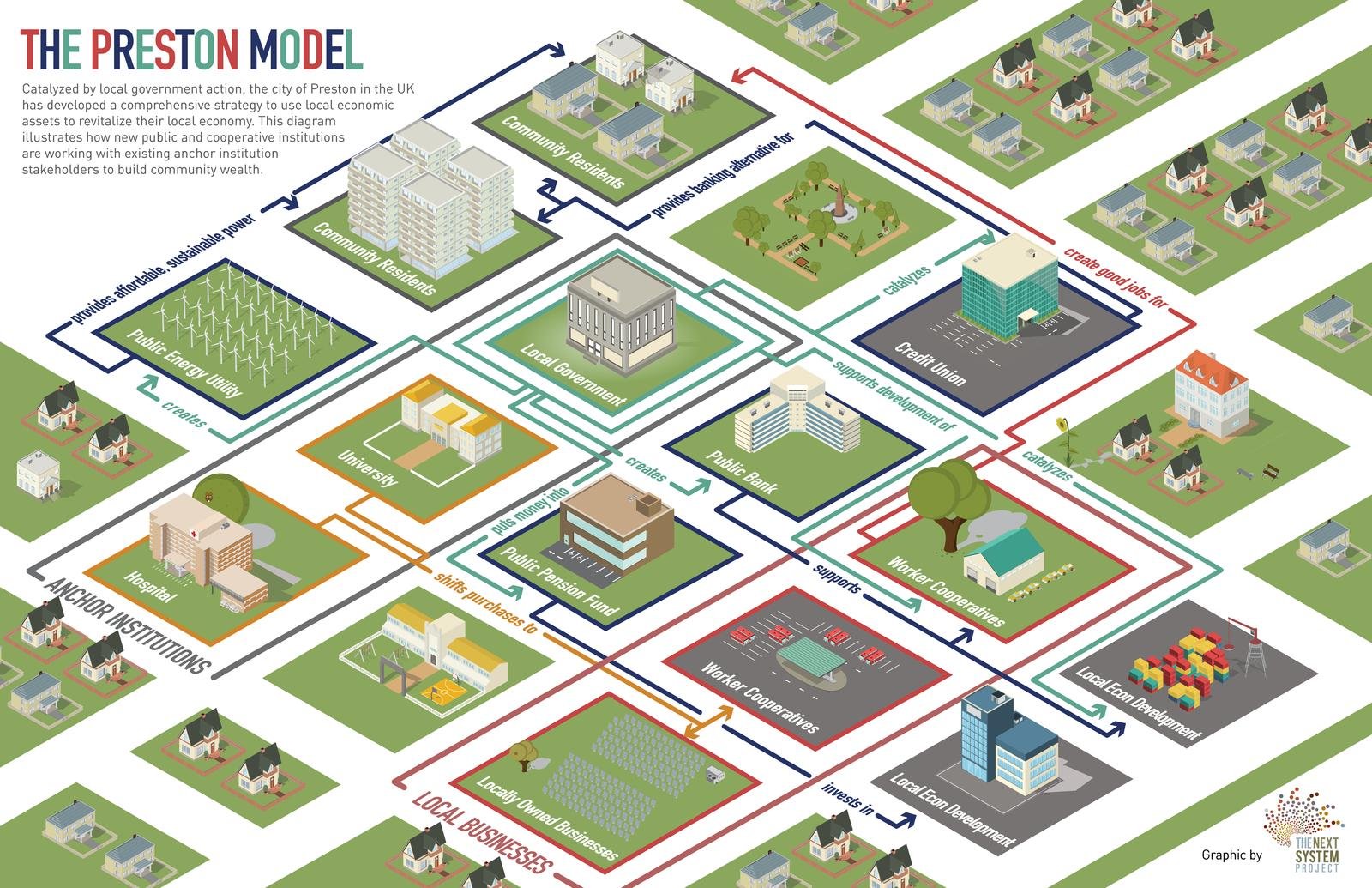
This was the paradox of its power and appeal – that the ordinary and everyday could be extraordinary. Through changes to procurement practices and institutional collaboration, Preston delivered definitive increases in local spend and employment. At the time of its emergence, it gave Community Wealth Building a tangible proof point in an otherwise desolate and bleak political landscape in Britain.
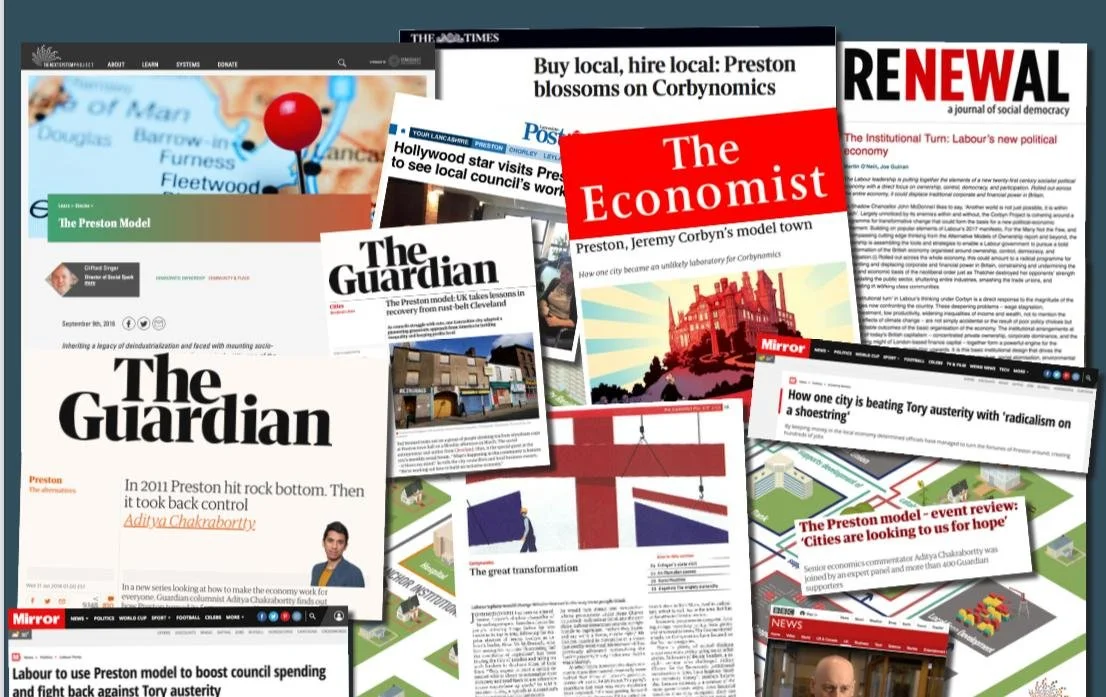
The excitement it conjured up – and it did, with widespread media coverage from The Guardian, the BBC and The Economist magazine – was because it brought to life again the hope and belief that something could be done to transform the operations of our ailing and unequal economies. It became for a time a shining city on a hill – at least metaphorically, if not especially so topographically.
But even at its peak, the Preston Model was never the sole testbed for Community Wealth Building, even in England. Community Wealth Building was and is and continues today to advance as a broader, growing international movement, drawing on multiple places, cultures, and struggles for economic justice and system change.
Preston has been a powerful and timely example, but it is but one node in a much larger ecosystem and network of thought and practice.
Strengths and Limits of the Preston Model
Preston's advances were concentrated primarily in anchor institution procurement reform, alongside some minimum wage and labor market gains. The other core pillars of Community Wealth Building – plural and democratic ownership of enterprise, land reform, locally-rooted finance, and fair employment – were less fully developed, at least in the initial phase.
This is not a criticism; it reflects the real constraints of what was possible, given the context of a relatively small lower-tier council with relatively limited budgets and spending power. What Preston did was open the door to progressive ideas around Community Wealth and that even small councils with limited budgets could advance things. That matters enormously.
“The Preston Model produced real economic gains. Spending was relocalized, multipliers were created. From one of the most deprived places to live in England, Preston became one of the most improved, including livability for families with children.”
The Preston Model produced real economic gains. Spending was relocalized, multipliers were created. From one of the most deprived places to live in England, Preston became one of the most improved, including livability for families with children. Compared to similar communities, there have been substantial median wage increases, reduced unemployment, mental health gains. Preston has consistently swum against the tide in a forbidding surrounding national environment.
It is also worth noting that this work unfolded largely without meaningful support from national government. The Preston Model was ignored by the Conservative government, at odds with its wealth-extracting city regional model and its general neoliberal economic outlook. However, the Preston Model from 2015 up until 2019 was buoyed by the enthusiastic support from the Labour Party and its then leadership – Jeremy Corbyn and especially John McDonnell – who saw in the approach a recipe for a wider local and national change based on greater economic democracy and social justice. A Community Wealth Building Unit was set up in the office of the Leader of the Opposition (LOTO) to promote the CWB model far and wide.

Joe Guinan/Jeremy Corbyn and John McDonnell championed the Preston Model
However, this initiative was cut off before it could properly begin. The enthusiasm from the top ended abruptly, with the ascent of the present UK Labour leadership and subsequently Labour government favoring traditional regeneration actions within Treasury-enforced economic orthodoxy. There was a move against such innovative policy radicalism for towns and cities and a return to a model of community economic development consisting largely of hanging baskets and empty gestures.
One could even say that the Preston Model was intentionally disrespected by the Starmer regime, representing a form of economic change that was increasingly at odds with the direction of both Labour Party and Labour government, whose line of sight was the City of London, corporate donors, and an economic growth model that favored financialization and wealth extraction, rebadging the problem as the solution, in keeping with half a century of economic failure.
Success from Below not Above
All in all, the progress made in Preston happened in spite of the wider political-economic system and was driven by local determination – a council and its leadership willing to act without waiting for permission from above.
That is both a testament to the grit of local actors and a reminder of the additional distance that might have been travelled, and the much more powerful outcomes that could have been realized with stronger structural and national political backing.
As an inspiration, however, it cannot be overstated. Preston became a widely recognized reference point not only in England but globally – a story that translated complex ideas around economic democracy and system change into something doable, concrete and legible, and that accelerated uptake elsewhere. Politicians, practitioners, and communities around the world found in Preston an idea and an example they could use. Many places in England during the 2015–2019 period learned from Preston and advanced their own approaches.
“Preston became a widely recognized reference point not only in England but globally – a story that translated complex ideas around economic democracy and system change into something doable, concrete and legible, and that accelerated uptake elsewhere. Politicians, practitioners, and communities around the world found in Preston an idea and an example they could use.”
From the groundbreaking work in Preston, and working with many other places in England and beyond, came the development of the five-pillar Community Wealth Building model that is now the standard in many localities across the world.
First North Ayrshire (a large unitary authority with a budget ten times larger than plucky little Preston City Council) under the then leadership of Joe Cullinane, and then Scotland as a whole, embedded Community Wealth Building within a national program, making it government policy with legislation to match.
In the United States, we took some of the learnings from Preston and reintroduced Community Wealth Building, going beyond its Cleveland roots, and helped to advance it, joining with groups on the ground in cities such as Chicago and St. Louis and Denver and Seattle and Atlanta.
World cities such as Amsterdam and Toronto, together with cities and regions in South Korea, Canada, Australia, Poland, and Ireland are each developing their own forms of practice, shaped by local conditions but connected by shared principles.
What is emerging is a universal adoption of the five pillars model of Community Wealth Building in varied contexts, alongside a widening shift toward democratic, place-based economic strategies – a politics of ownership and resilience.
The wider agenda is stronger because of Preston. Preston strengthened the legitimacy, confidence, and political traction of Community Wealth Building as a serious economic alternative, not a utopian aspiration.
And its legacy endures, regardless of how things now evolve on the ground.
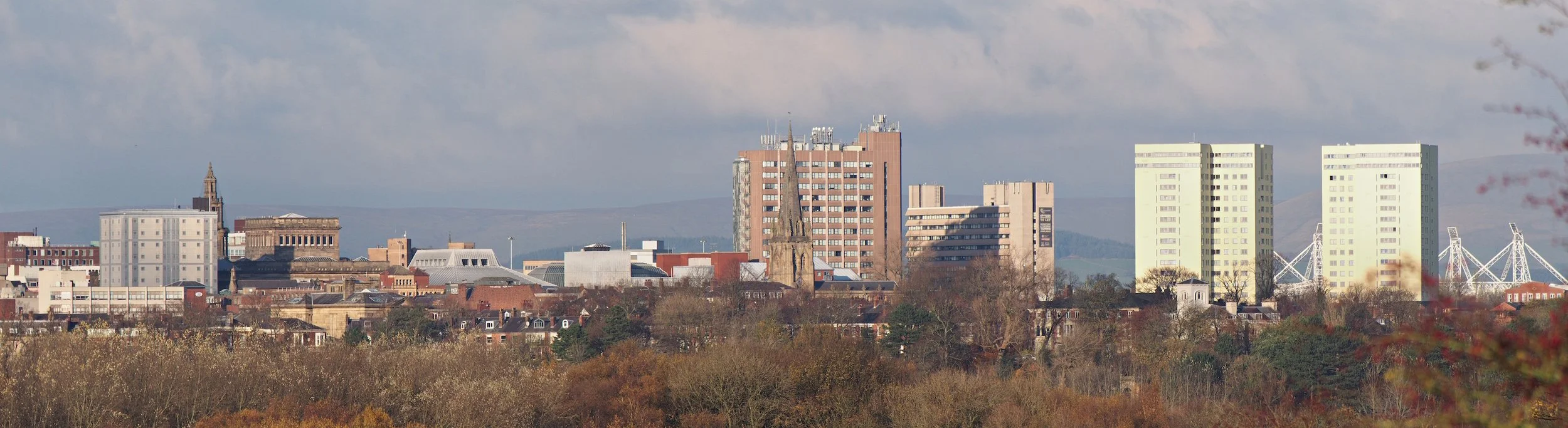
Preston skyline
The original Preston Model will continue to develop – that is the nature of all living experiments in policy and practice. It has gained some wider community and local public anchor institution buy-in, and that will endure. The behaviors within the council and other institutions and in policies such as procurement will stand the test of time. Cooperative development is no longer marginal but a key option.
Where wealth was once treated as a generalized outcome, patterns of ownership and flow are now everyday considerations. And the core ideas that Preston helped make visible – local economic resilience and multipliers, anchor collaboration, democratic ownership, and the right of communities to shape the economies they live within – continue to animate policy and practice across the world.
The Preston Model was and is an inspiration, and the work and its legacy continues.
For press comment from The Democracy Collaborative, please contact Joana Ramiro jramiro@democracycollaborative.org