
April 28, 2026
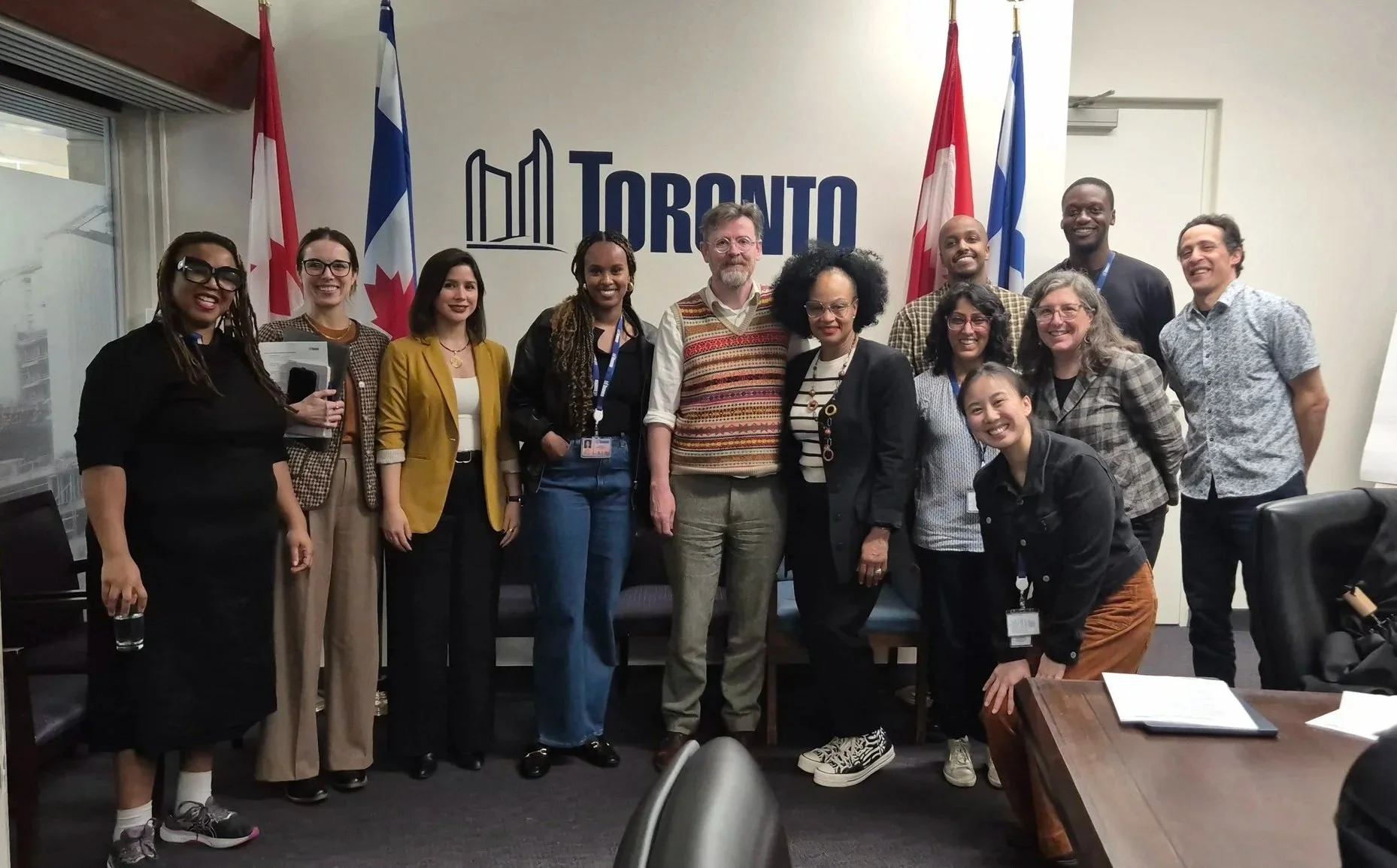
TDC Global Lead for Community Wealth Building, Neil McInroy, was recently in Canada, where he witnessed once more how CWB has moved from the margins towards the mainstream of local economic thinking.
Invited by the Atkinson Foundation, I’ve just spent four intense days in Toronto, immersed in conversations about Community Wealth Building. Toronto is a multicultural and diverse city of enormous scale and wealth. Like everywhere else — Canada included — it is grappling with overlapping crises produced by a changing, and failing, economic order.
It was a time for learning and sharing. And, like all global cities wrestling with the brutal logic of late‑stage capitalism, Toronto left me with two competing feelings: a deep sense of the sheer magnitude of the challenge before us and, crucially, an renewed conviction that we already have the tools to act.
As in all big cities Toronto is shaped by investment flows that arrive at speed and extract at scale. Glass towers hit the clouds, property and finance set a familiar agglomerated pattern of wealth accumulation that, while appearing impermeable, feels increasingly fragile. As in London, New York or Vancouver, the prevailing model of economic development concentrates wealth, externalizes cost and locks in place inequality. Against that backdrop, neighborhoods and buzzy human life is in evidence, but inequality runs deep, the cost‑of‑living crisis is biting, gentrification continues to displace, and ecological breakdown is accelerating.
“And yet, this is what struck me most over these few days: The orthodox economic tectonic plates are shifting.”
At one dinner a business woman sitting next to me put me at ease by telling me an old Canadian joke: Do you know why Canadians cross the road? To get to the middle. What that conversation then exposed was how fragile — and politically exposed — that familiar social‑democratic “middle” has become. The liberal democracy that Canada has been so successful in forging is now under strain like never before. Trade and political pressure constantly advancing from south of the border (“like living above a Meth den”, as one Torontonian described it). When the neighbor is volatile and the landlord is corporate capital, centrism stops looking like stability and starts looking complicit.
Let’s call it, democracy in Canada, in Toronto and everywhere, is being hollowed out by the dominance of footloose capital and a small number of extraordinarily powerful economic actors (mostly men). Furthermore, deep change is often constrained by a lingering centrist belief that capitalism can be endlessly moderated without ever re‑engineering who holds power within it (what Joe Guinan and I have called the delusional moment: the belief that capitalism can be endlessly moderated without ever redistributing power). The reality is that when economic power remains this concentrated, political democracy becomes thinner and more performative, reduced to managing symptoms rather than shaping outcomes.
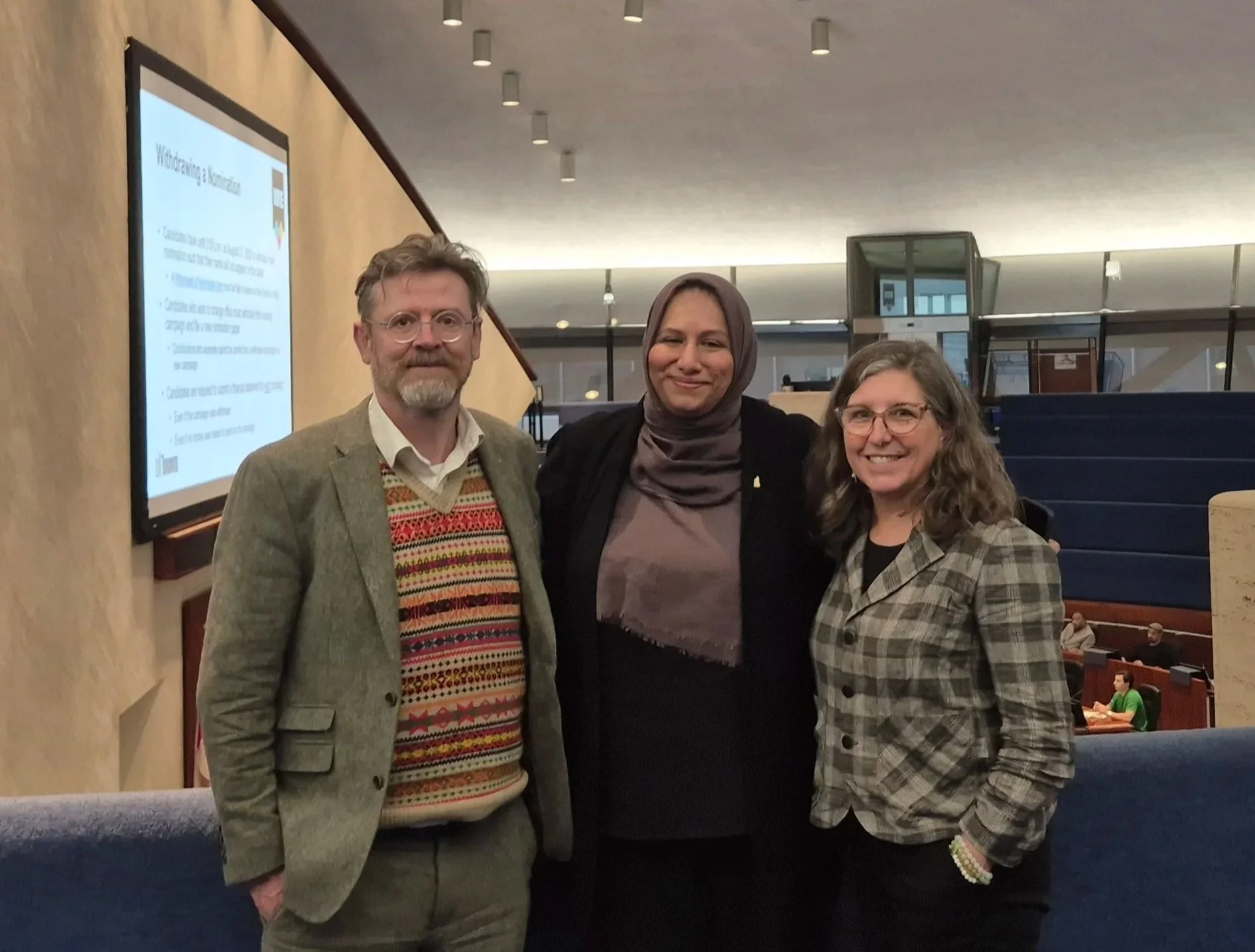
Neil with Toronto Deputy Mayor Ausma Malik and Atkinson Foundation CEO Colette Murphy
This is precisely where Community Wealth Building enters the frame. Not as a policy add‑on or a softer form of capitalism, but as a form of applied economic democracy and a direct challenge to where power sits in the economy. CWB starts from the recognition that democratic politics cannot function properly when there is no meaningful democratic control over assets and investment. By reshaping ownership and institutional power at the local level — through land, labor, procurement and finance — it strengthens democracy itself, not in theory but in practice. As was conveyed at the Democracy Xchange event that I also attended, political and economic democracy are two sides of the same coin.
On the first day of the event, I joined a 40‑strong conversation about how Canada grows its “new economy” sectors. Social economy leaders, funders, policymakers and foundations filled the room. There was a shared recognition that the situation is grave, long past the point where simply naming injustice will do. But in terms of prescription, the room felt uncertain.
Some were committed to a familiar social economy path, often deliberately depoliticized. Others were more alive to the need to act politically and to scale their activity with intent and seriousness. As an outsider, I sensed unease — and a strong pull towards what is already known. Much of the conversation focused on doing more of the good work that already exists; fighting the same battles, just harder. But as I kept saying, that is not enough.
Some talked of wellbeing economy and positive social policy. But warm narratives do not house people. They do not rebalance ownership. They do not decarbonize production. And they certainly do not democratize power.
“We need to get bolder. We need to scale. And we need to make a much bigger play. One rooted in Community Wealth Building and economic democracy.”
I suspect some saw me as the “radical Scot”, rather than a sensible pragmatist. In truth, I was making a deeply conservative argument: If democracy is to survive, it must have an economic foundation.
One evening crystallized much of this for me. With 40 others, I attended a dinner at the Toronto Club, with Daron Acemoglu, winner of the 2024 Nobel Prize in Economic Sciences. The conversation was learned and sharp. One observation lodged itself firmly in my mind: Acemoglu noted that the British Empire, at the height of its power, controlled a smaller share of the global economy than today’s seven largest technology corporations.
We are living through an era of extraordinary economic concentration, unparalled in Human history. One where corporate power routinely dwarfs democratic authority. National governments, even when well‑intentioned, struggle to regulate, tax or restrain actors whose reach is global, and where there wealth is peripatetic and mobile. The question that followed was unavoidable: If national political democracy is straining under this weight, where does counter‑power come from?
Part of the answer — an essential part — lies in economic democracy. Community Wealth Building is a vital facet. By expanding democratic ownership, rooting capital in place, strengthening worker voice and reshaping the behavior of anchor institutions, CWB redistributes power as well as wealth. It does not wait for global governance to be fixed or markets to miraculously self‑correct. It builds a democratic economy from the ground up, city by city, institution by institution, neighborhood by neighborhood.
What distinguishes Community Wealth Building is its refusal to remain abstract. It does not settle for critique alone. It asks practical, unsettling questions:
Who owns the economy?
Where does wealth flow?
How do everyday decisions on procurement, land, labor and finance shape outcomes?
And how can institutions rooted in place be mobilized to build long‑term, shared prosperity?
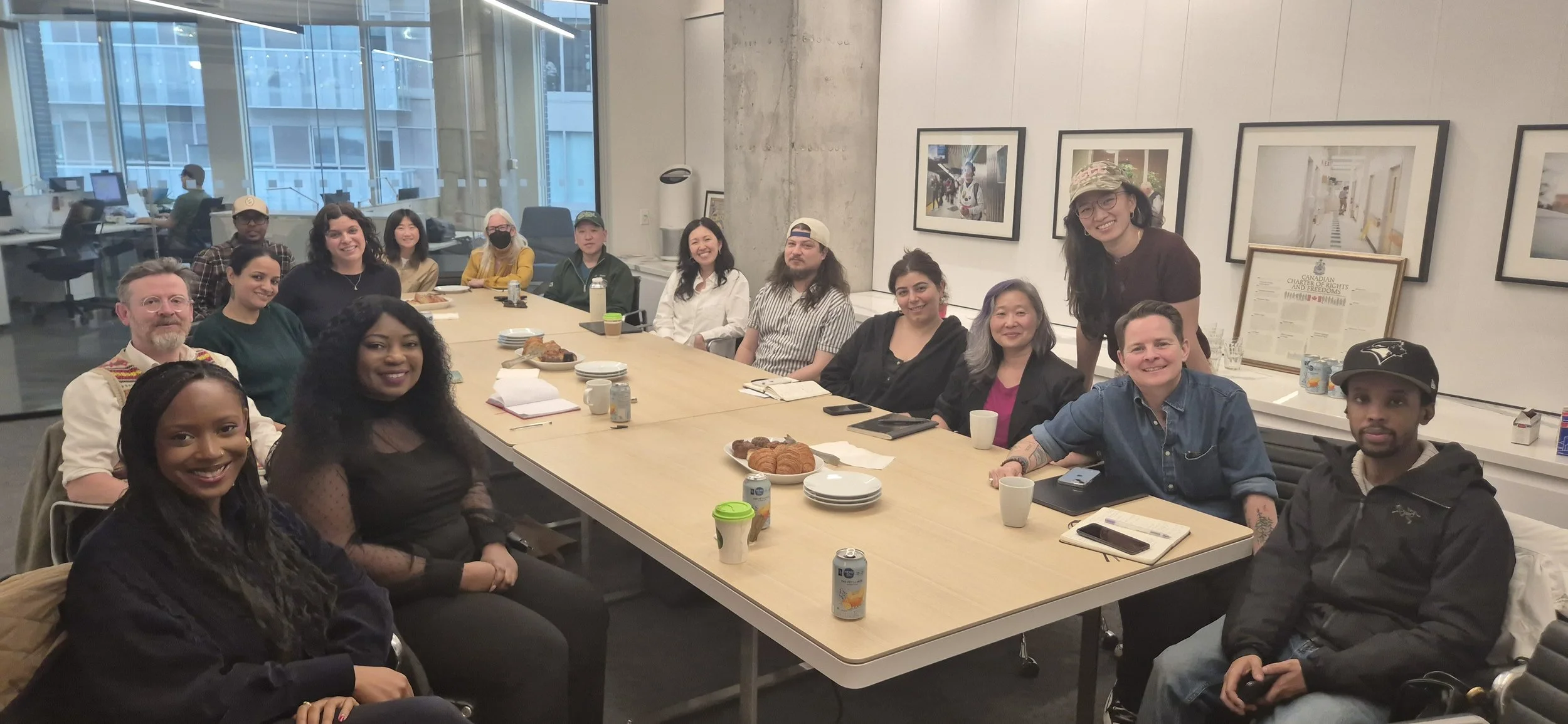
Neil with a group of Canadian community wealth builders
In Toronto, I saw people grappling with these questions for real, through procurement reform, social purchasing, cooperative development, community land strategies and local investment. This is economics with its sleeves rolled up and its eyes wide open.
In meetings with City officials in the splendor of Toronto Town Hall, I learnt of the recently published ten‑year review of Community Wealth Building and developed a draft Inclusive Economic Strategy. These are sister documents. The next step, to my mind, is obvious: they need to be fused into a single, coherent political and economic project.
But here’s the rub. Big cities like Toronto — steeped in social democratic compromise — are often reluctant to antagonize big capital, mainstream economics and an electorate that is less radical than some of its elected representatives. That tension was palpable. Listening to Mayor Olivia Chow speak, and in a wide ranging meeting with the impressive Deputy Mayor Ausma Malik, it was clear that City leadership experiences this as a tightrope: go too progressive and get shot down, and risk the ire of big capital; move too slowly and get shot down anyway.
“One of the most energizing aspects of this trip was the unmistakable sense that we now have a CWB movement, not just a collection of experiments.”
From Canada and the U.S., to Scotland, Ireland, South Korea, Australia and Amsterdam, Community Wealth Building has moved from the margins towards the mainstream of local economic thinking. Different contexts, yes, but strikingly similar challenges and aligned responses.
The time for procrastination is well and truly over. There us no need for perfect conditions, and no justification for retreating into system‑level chatter while communities struggle and planet burns. Community Wealth Building shows that we can act now, using powers and resources already at hand, while still pushing for deeper structural change. Toronto embodies both the excesses of extractive capitalism and the promise of collective, place‑based action. Extraordinary wealth alongside deep inequality. Global capital alongside deeply rooted organizations refusing to accept that this is simply “how the economy works”.
Over these four days, I was reminded, again and again, that Community Wealth Building is not a silver bullet. But it is one of the most credible, actionable approaches we have for confronting today’s economic realities without surrendering to despair.
If one message echoed throughout my time in Toronto, it is this: the time for advancing and scaling is now. We do not lack ideas. We do not lack evidence. And increasingly, we do not lack allies. The projects that show us the future are all around us, but they ‘win in spite of the system. That tells us we need to change the system. The economy system we live under with is not inevitable. It is built, daily, through policy, institutional practice and power relations. And it can be rebuilt, deliberately and democratically.
That conviction, more than anything, is what I’m taking home from Toronto.