
Four Days in Dublin, Ireland: Igniting Community Wealth Building
May 4, 2026
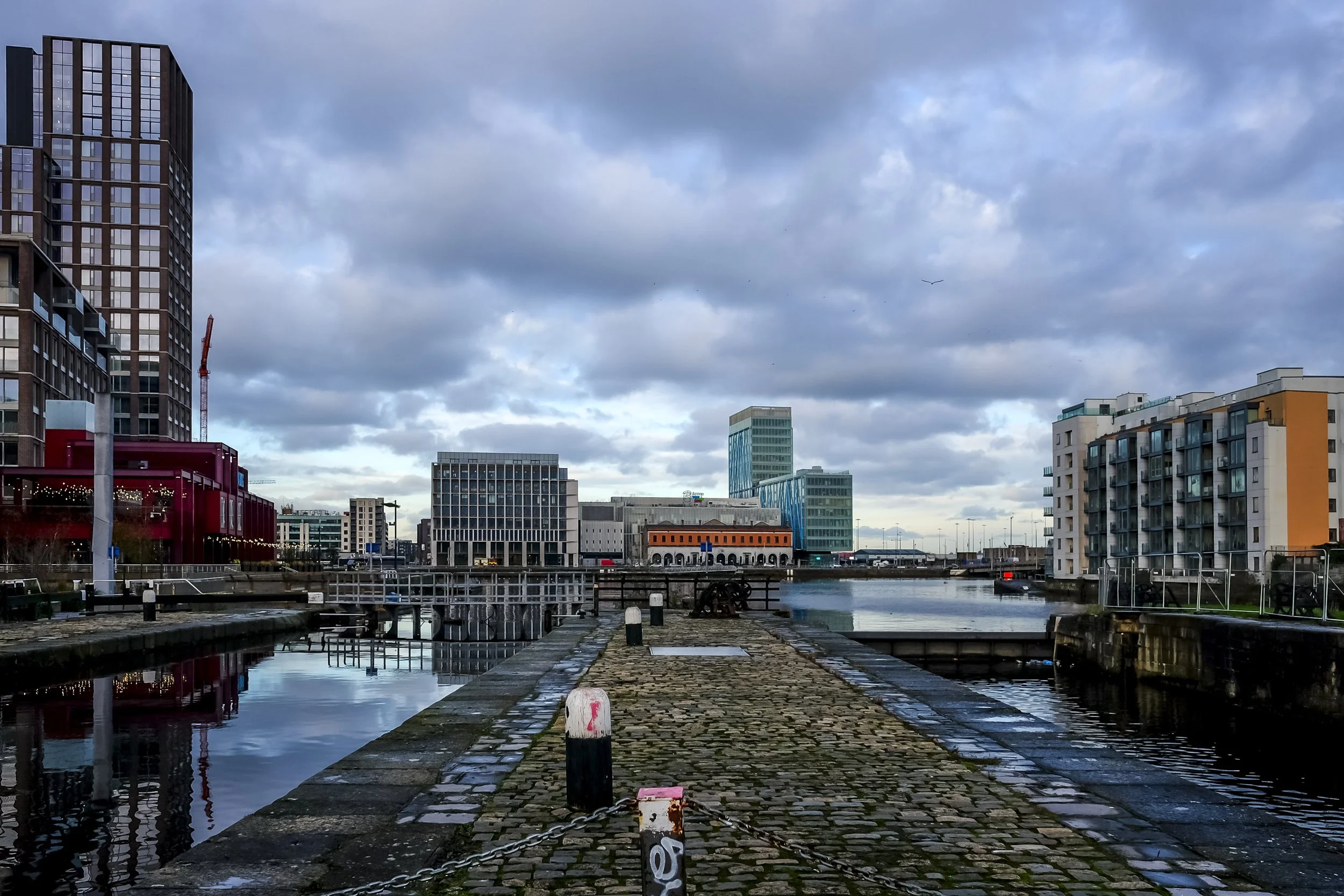
Getty Images/Dublin docklands and IFSC financial district
Neil McInroy was part of the TDC team of international experts helping Bohemians FC launch their new Community Wealth Building strategy over four days in Dublin. He shares his reflections on where next for CWB in Ireland.
Four days in Dublin, hosted by Bohemians Football Club, offered a powerful reminder of the many and varied starting points for Community Wealth Building (CWB) as transformative change. Government strategy and plans is one way (and it is needed), but also key is the energy from below – the sparks! And, crucially, how those sparks come together and ignite into something much bigger: a movement, a practice, and a policy framework working together, to create powerful economic system change.
Bohemians are, of course, no ordinary club. Founded in 1890 and a beacon of progressive politics, they are fan-owned and values-led. As a football club, they embody in microcosm the kind of economy Community Wealth Building is trying to build: one where ownership is shared, purpose matters, and wealth is not simply extracted but held and circulated.
Their invitation to The Democracy Collaborative – Joe Guinan, Ted Howard, Matthew Brown and myself – was not just about an exchange or our endorsement of their strategy, which we welcome. It was an opportunity to explore and assess where Bohemians, Dublin, and Ireland were at on economic system change, and to advise on where they go next.
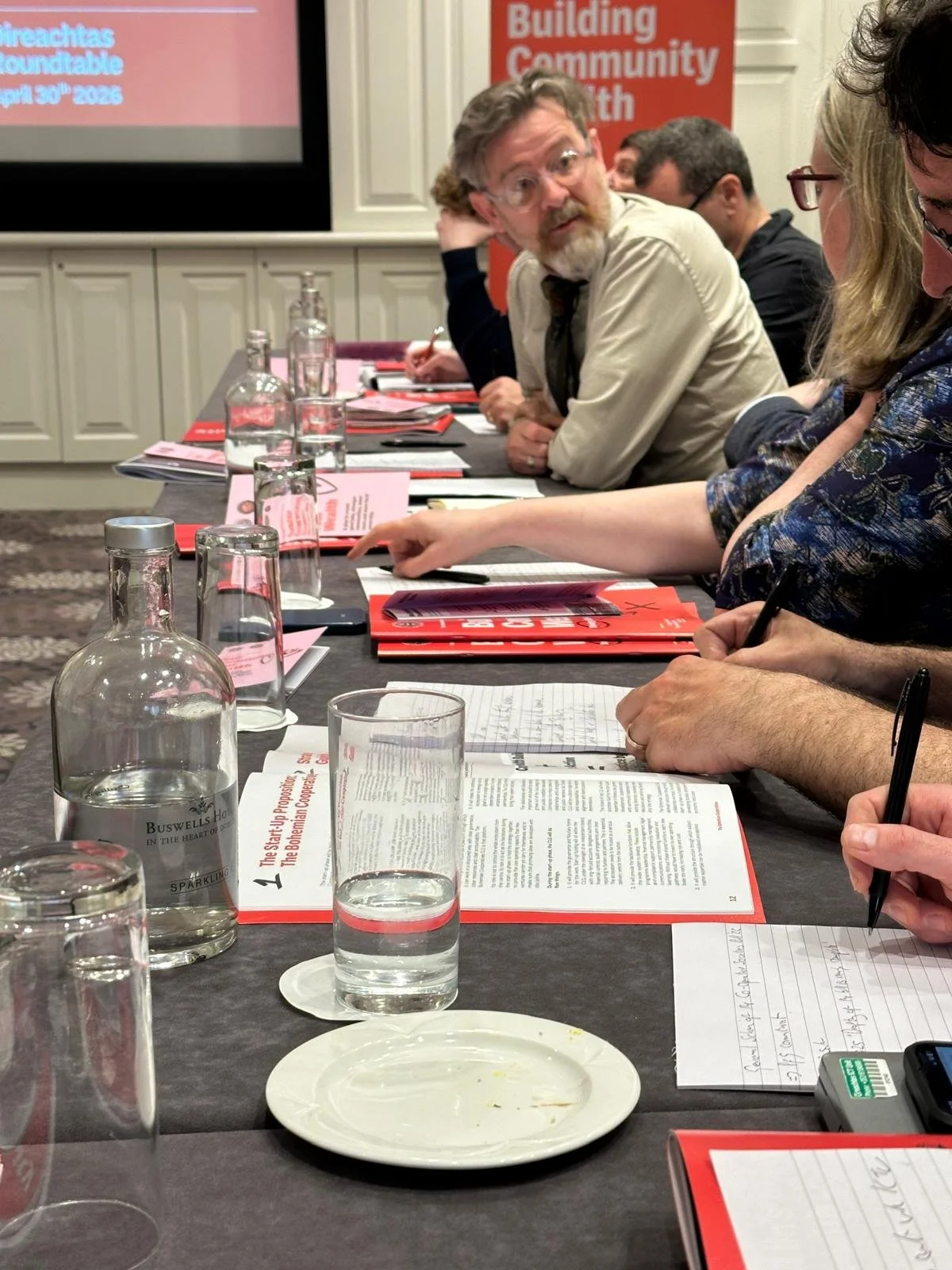
Ted Howard/Neil McInroy with Oireachtas members
Across the world, Community Wealth Building often begins with a spark. A sense that the economy is not working for folks and something needs to be done. It could be a local initiative, the setting up of a cooperative, a campaign focused on poverty or any injustice. But the real test of any spark is whether it can grow into a conflagration capable of producing something more systemic.
Community Wealth Building has many sparks. And some have fizzled out. However some have been maintained even though the flame never really grows into something systemic (i.e. the original CWB model of the Evergreen Cooperatives in Cleveland), whilst others have grown but have been contained by wider political or movement constraints (i.e. the Preston Model), while still others look to be growing as a strategic and systemic economic development approaches with national economic girth and reach (i.e. the progress on national-level CWB policy in Scotland).
Three Legs to the CWB Stool
What is essential for the growth of Community Wealth Building is a recognition that systemic problems need systemic solutions. And that depends not just on energy, but on the interplay of three essential forces that we at TDC call the three legs to the stool: organized people (movement), real-world examples (practice), and structural change (policy) working together to build a democratic, locally-rooted economy
Taken individually, small scale efforts at systemic change will be thwarted. Movement alone can be a shout in dark, practice can be just isolated case studies, and policy alone can be top-down strategy with little purchase and buy-in. And in this, political economists, think tanks, politicians, economic strategists, and alternative theorists can arguably be the weakest of all sparks. Their knowledge whilst empathic to those at coalface of injustice is often detached, with a retained top-down faith in hidebound bureaucracy in face of unassailable countervailing economic forces.
What was striking over the four days – in meetings with Dublin City Council, in discussions with national parliamentarians from the Oireachtas, in the formal launch at Mansion House (read the closing speech by my colleague Joe Guinan here) and the wider civil society from across Ireland gathered in the presence of Uachtarán na hÉireann (President of Ireland) Catherine Connolly – who strongly endorsed Community Wealth Building as a hopeful direction for the country – was that a sense of alignment was beginning to form. Not yet solid, not yet embedded, but clearly discernible. The outlines of something larger and more ambitious.
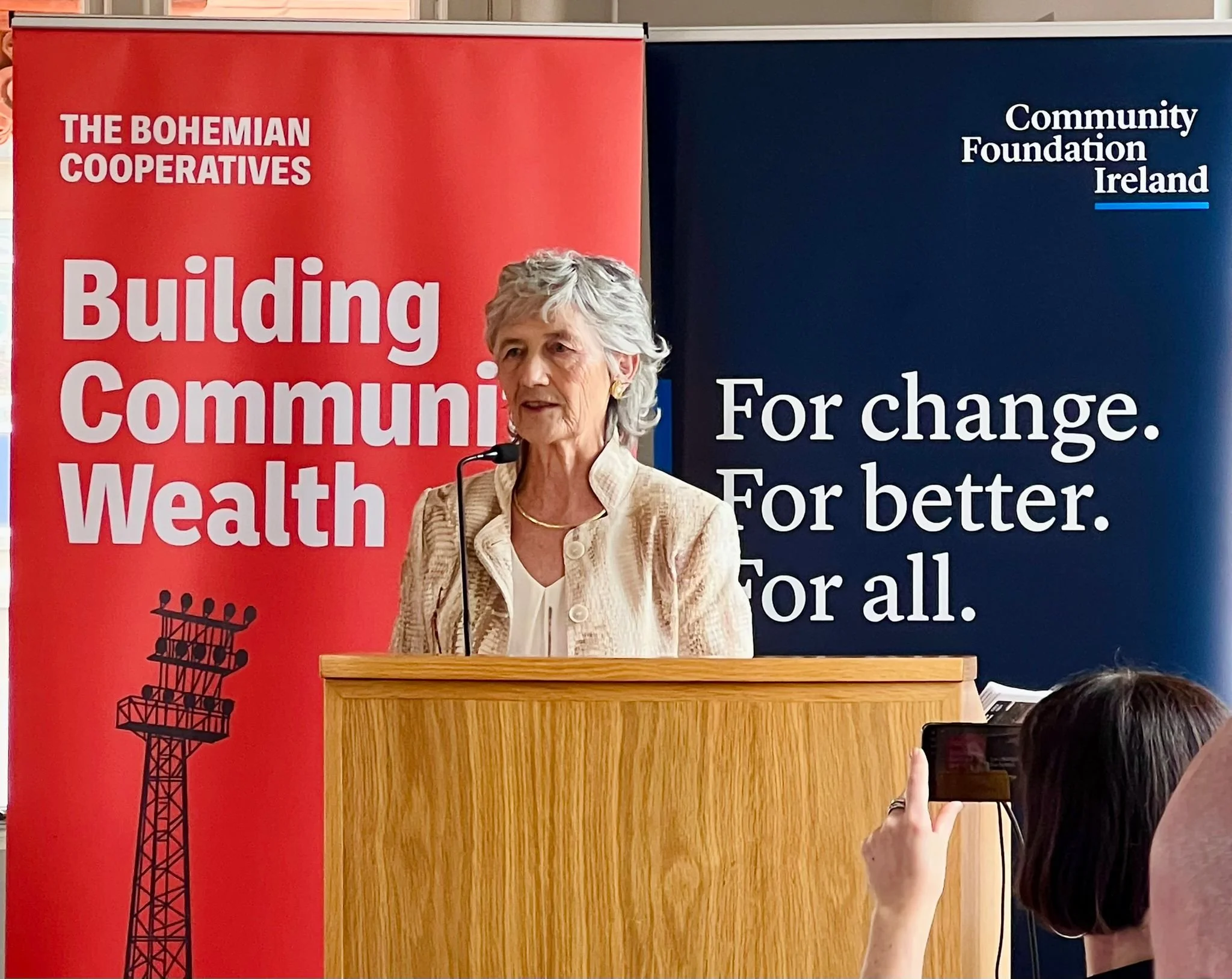
Martin O’Neill/Uachtarán na hÉireann Catherine Connolly at the civil society roundtable.
However, the balance between the three “legs of the stool” is still uneven in Ireland.
The movement is perhaps the most visible at this stage. There is real civic appetite: an obvious recognition that the current model is not working for enough people, and a willingness to explore alternatives. The coalition assembled around the launch – spanning economic, social, and environmental actors – speaks to this. So too does the integrity that Bohemians bring as a convening presence and vector of cultural power capable of reaching beyond the usual suspects.
Movements only endure if they broaden far beyond such a starting point. Community Wealth Building in Dublin, and in the rest of Ireland, must stretch beyond early adopters and committed insiders, reaching trade unions, the civil society sector, climate groups, cultural actors, politicians, anchor institutions, building a shared language and a shared stake and some real political power and oomph.
Practice, meanwhile, is emerging more tentatively. There is intent, certainly: conversations around procurement, around the role of anchor institutions, around new ownership models, around aspects of the CWB five pillar model. But CWB only becomes real when all five pillars are adopted, strategically aligned, and work as a comprehensive suite: where procurement shifts, new democratic enterprises are created, patterns of land ownership and finance are reorganised, and work is fully valued, with workers’ rights hardwired in. Without this, the hopeful energy generated at conferences and launches risks dissipating. Practice is what turns belief into credibility and results.
Policy remains the least developed of the three – but also the most decisive. There were encouraging signs: engagement from elected representatives, discussion of an all-party parliamentary group in the Oireachtas, genuine interest from within local government, including senior officers.
“For Community Wealth Building to take root in Dublin, it must become part of how Dublin City Council thinks and acts strategically, and it must take real and concrete form – beyond what they have already tentatively advanced through existing work on Community Wealth Building. Moving forward CWB needs to be seen not as community development but as core to economic development and to overall economic policy and strategy.”
Yet for Community Wealth Building to take root in Dublin, it must become part of how Dublin City Council thinks and acts strategically, and it must take real and concrete form – beyond what they have already tentatively advanced through existing work on Community Wealth Building. Moving forward CWB needs to be seen not as community development but as core to economic development and to overall economic policy and strategy.
Without this anchoring, progress will remain partial and contingent, and risks being subsumed in the wider economy of ongoing extraction and financialization.
Ireland’s Financialized Economy
All of this matters because of the wider economic reality which Dublin sits firmly within.
Ireland’s growth model has been, by conventional measures, extraordinarily successful. But it is also deeply imbalanced and fragile. A highly globalized, FDI-driven economy has delivered scale and dynamism, but at the cost of disconnection. Around a quarter of GDP flows abroad – a striking indicator of how much of the wealth generated does not stay rooted in place.
The dominance of multinational capital, while beneficial in certain respects, has also created an economy where local linkages can be thin, and where prosperity does not translate into broad-based wellbeing.
Dublin like all big cities is a place of contradictions. A vibrant city economy with global connectivity, yet a place struggling with inequality, gentrification, congestion, and growing cost-of-living pressures.
This is why the case for Community Wealth Building is never that it is a nice to have, peripheral add-on and extra to mainstream economic policy and strategy, but instead an essential correction to it and its failings.
“Dublin like all big cities is a place of contradictions. A vibrant city economy with global connectivity, yet a place struggling with inequality, gentrification, congestion, and growing cost-of-living pressures. This is why the case for Community Wealth Building is never that it is a nice to have, peripheral add-on and extra to mainstream economic policy and strategy, but instead an essential correction to it and its failings.”
Community Wealth Building does not reject the global; it seeks to rebalance it. It asks how we ensure that more of the wealth generated in a place is retained, recirculated, and democratically controlled. It is concerned with ownership – who has it, who doesn’t, and how that shapes outcomes. And it is concerned with power – shifting it, embedding it, and making it accountable.
This is why it is so important to resist the temptation to see Community Wealth Building as a collection of projects. A procurement initiative here, a cooperative there, a strategy document launched, a victory lap on a short-term gain. These are important, but they are not the point. The point is system change. A gradual, contested, but deliberate rewiring of the local economy to one that genuinely serves people, place and planet.
For that to happen in Dublin, the enabling conditions now need to deepen. Institutional alignment, particularly within Dublin City Council, will be critical. Political leadership must mature from curiosity into commitment. The civic coalition must widen and knit itself more tightly together. Early practical interventions must demonstrate that this approach works, not just in principle but in practice. And the narrative must stay clear: this is about transforming how the economy functions, not simply improving it around the edges.
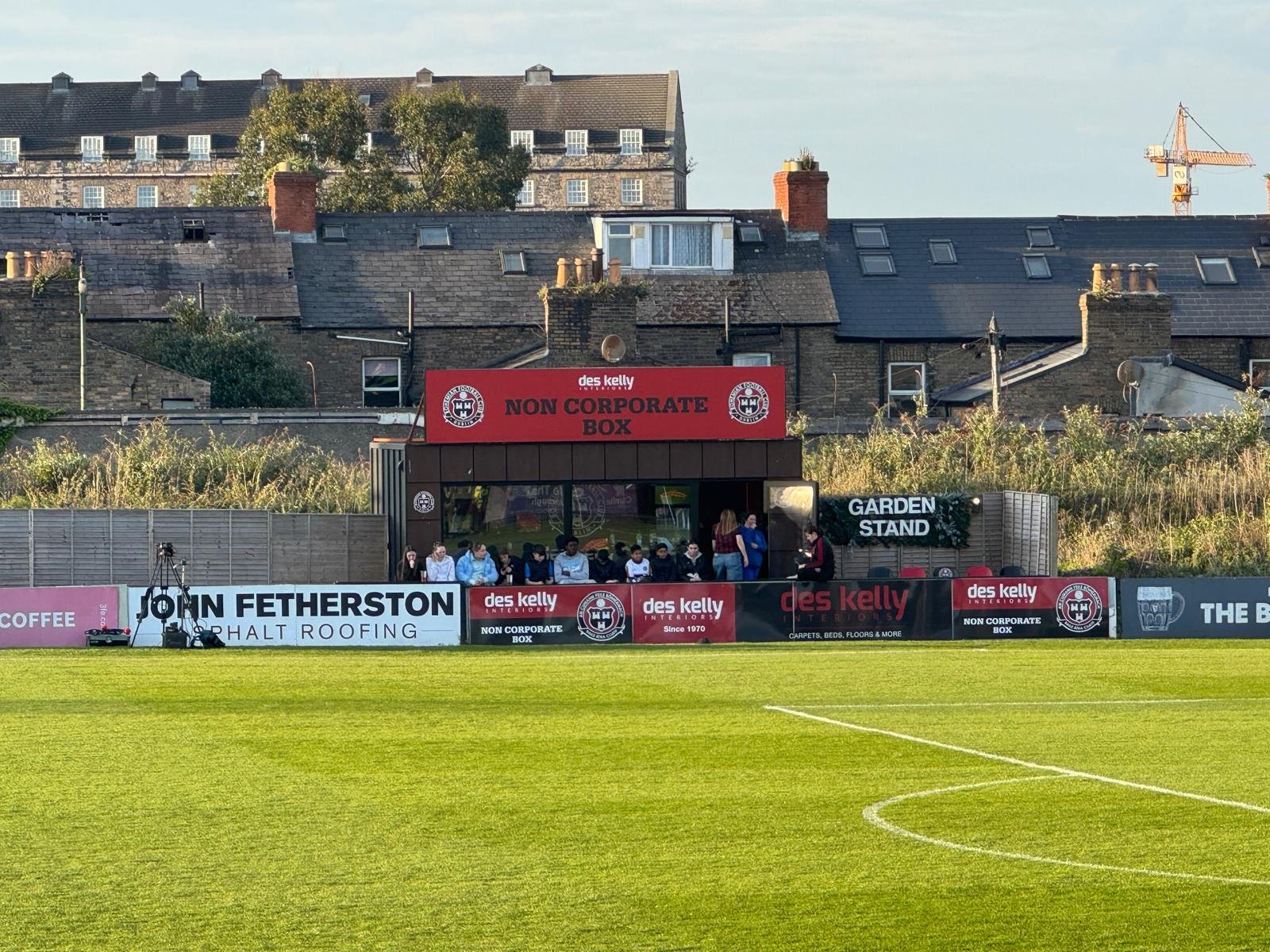
Newsha Mohazzabi/Dalymount Park, home of Bohemians FC
Bohemian Cooperatives as Community Wealth Building
What the Bohemians have done – and it is critical and should not be underestimated – is to have blown the starting whistle. They have shown where a beginning can come from. They have kicked off, convened players, and have a strategy to deliver.
“What Bohemians have done – and it is critical and should not be underestimated – is to have blown the starting whistle. They have shown where a beginning can come from. They have kicked off, convened players, and have a strategy to deliver.”
But they cannot be the whole story. Nor should they be. They know this and are clear about it.
The success of their strategy will depend on how quickly and effectively it moves beyond any single organization, starts to touch strategically across all five pillars of CWB, and becomes embedded across the city’s institutions and communities.
There are many starting points for Community Wealth Building. In Dublin, it happens to be a popular and vibrant fan-owned football club. What matters is not where it starts, but whether it grows – whether the spark ignited by Bohs becomes a movement, whether the movement drives practice, and whether that practice is secured through policy. And thus ultimately whether a just and democratic economy for all is achieved.
Dublin has its vital spark. The task now is the hard work and the abiding question – can it safeguard the flame, spread the fire, and scale and amplify to the point where transformation occurs.
We look forward to working with everyone in Dublin and doing our small part to ensure that this is exactly what happens next.