
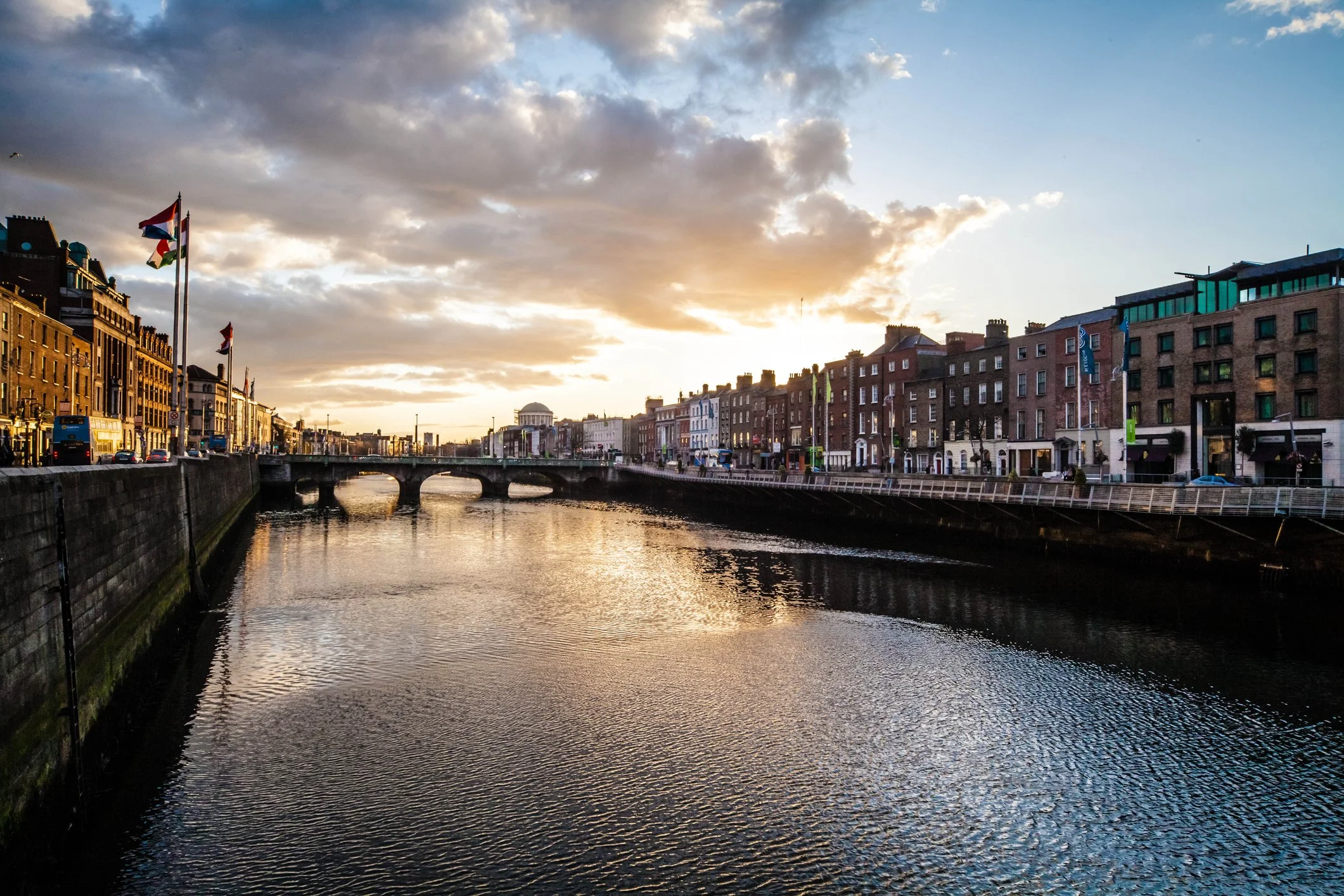
Building a democratic economy in Dublin
Bohemians launch a Community Wealth Building strategy for Dublin and Ireland
April 30, 2026
Getty Images/Angelafoto
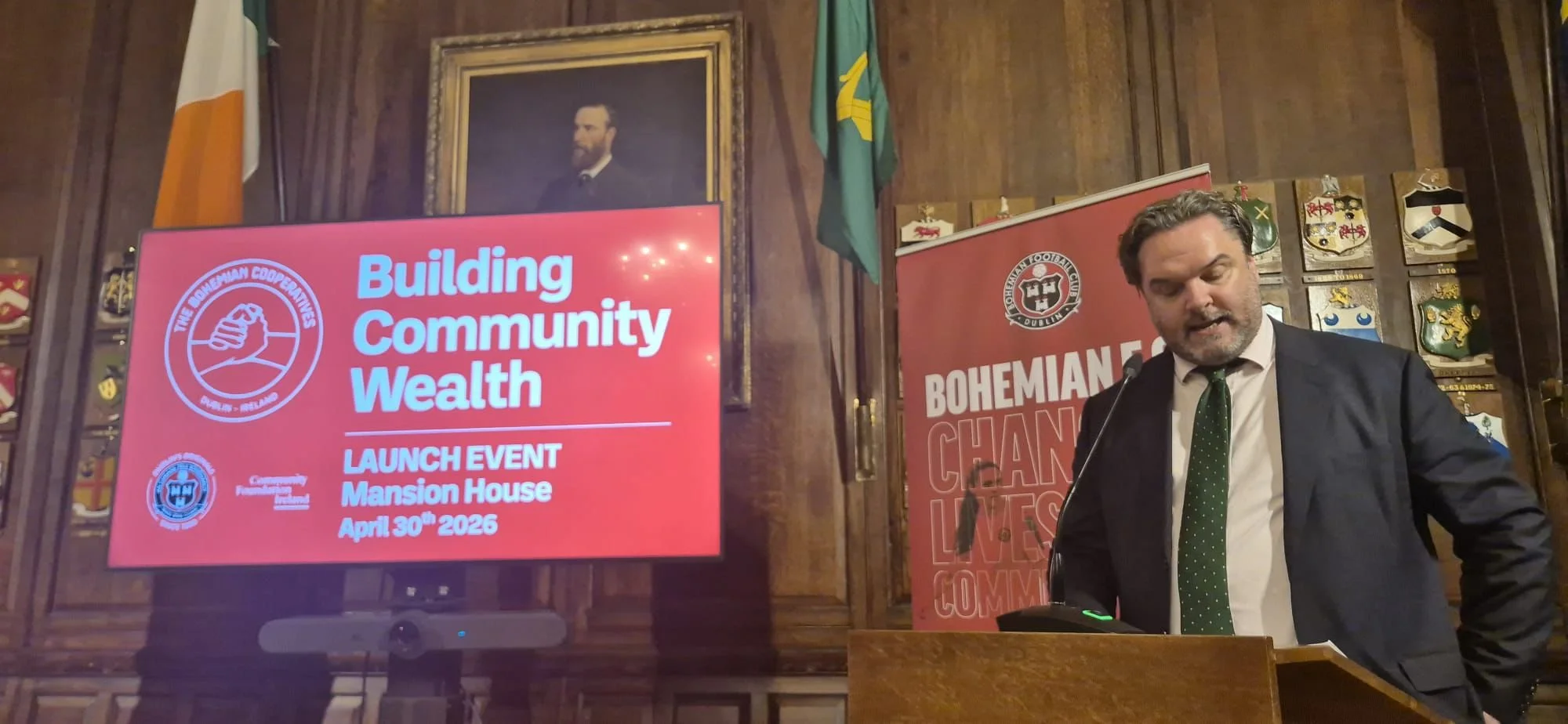
TDC President Joe Guinan was invited to give the closing speech at the official launch of the Bohemian Cooperatives at the Mansion House in Dublin. The text of his remarks is below.
Thank you to the Dublin Bohemians for inviting me here to speak at this hugely significant moment for the future of this city and country.
Something very important has happened here today.
I want to congratulate the Bohs and everyone involved in the launch of this new three-year Community Wealth Building strategy for Dublin.
If this strategy is implemented – and we all of us here, individually and collectively, need to work make sure that if becomes when – when this strategy is implemented, the Bohemians will have played a profoundly important and catalytic role in putting back on the table a very different vision for the Dublin economy.
Because Community Wealth Building, as we have heard from the discussions, and as we know from the increasing spread of examples from all around the world, is about building a different kind of economy.
Not an economy of increasingly elusive neoliberal growth and financialization, with the empty promise – all too often honored in the breach – that with growth we have the resources that mean that – through regulation, or after-the-fact redistribution – we can somehow achieve equity and equality and inclusion and ecological balance and a flourishing of community from a lopsided economic model.
Instead, by committing to an economy of building community wealth, the Bohs have put something back on the table that should never have been lost.
This is the vision of the good society.
Envisioning the Good Society
What if, each day when we wake up, we could know that we were waking up to an economy that was automatically getting better for everyone?
We’ve somehow grown so used to the way things are that we’ve forgotten how to imagine such an economy.
Let’s imagine it together.
This is a moral economy, a democratic economy.
Finance in this economy is put back in the service of people, communities, and the planet.
In this economy, labor comes before capital.
Good decent work is a core social aim and source of individual development.
Ownership is not concentrated but broad-based and widely shared.
And stewardship is the basis of ownership, not exploitation.
This is a real and not a financialized economy.
All economic activity occurs in real places, and communities are able to take control of their own destinies.
It is a collaborative economy, in which human flourishing occurs in healthy communities and a livable planet.
This economy recognizes that we have only one planet, on which all life is interdependent and real ecological boundaries require limits to growth.
Human development is the real face of freedom in this economy, requiring removal of unfreedoms such as poverty and the lack of opportunity.
Government plays a big role in this economy, in a democratic and decentralized fashion.
It is recognized that our collective ability to govern ourselves is the bedrock of the good society.
The institutions of this democratic economy are consciously designed and controlled to serve the common good.
This economy is harder to imagine.
Perhaps because we’ve forgotten how to hope, how to demand.
“We’ve impoverished our imaginations, and as a result it’s harder to imagine an economy in which, when we wake up each day, we can know that in and of itself the economy will produce better outcomes.”
We’ve impoverished our imaginations, and as a result it’s harder to imagine an economy in which, when we wake up each day, we can know that in and of itself the economy will produce better outcomes.
Greater equality.
More democracy.
Healthier people and communities.
A cleaner environment.
It’s hard to imagine – but not impossible.
And more and more people are doing it.
*
The most exciting thing to me about the democratic economy is this: that it is not some pipe-dream but already emerging all around us – a spontaneous response to social pain by people in some of our poorest communities.
Traditional policies and approaches have demonstrably failed them, and as a consequence, more and more people are beginning to turn to genuine economic alternatives in which new wealth is built collectively and from the bottom up.
Getty Images/Stephen McCarthy
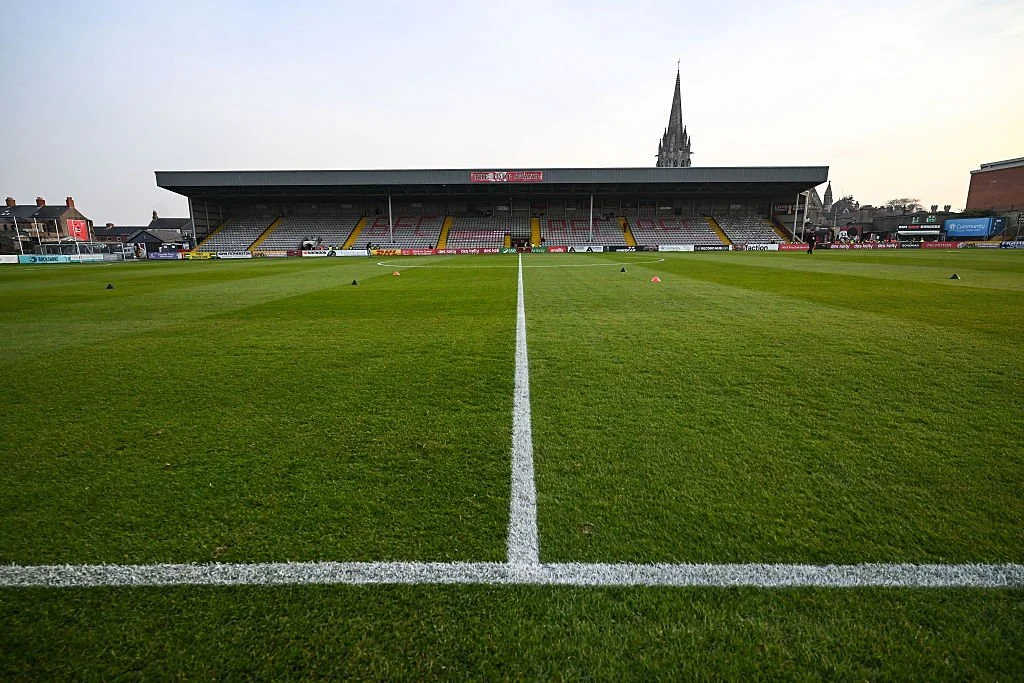
All of this is grist to the mill for the Bohemian Cooperatives and this exciting new Community Wealth Building strategy in Dublin and Ireland.
When you think about the possibilities inherent in this vision, think about what it would look like to go all in.
Ted Howard knows this well, but for a long time we at The Democracy Collaborative have been reaching for the opportunity of realizing something we call internally “The Mosaic” – the bringing together in one place not just of a collection of democratic economy projects and initiatives but a knitting together of them all in a unified strategy for economic and social transformation at the municipal and regional level that begins to achieve some of the ambition of what can deservedly be called a next system.
Imagine not just a land trust or a public bank or a network of co-ops or an insurance mutual or a new community-owned digital infrastructure or participatory budgeting or new forms of guaranteed income, but all of them, in their best-in-class versions, being brought together in one place.
“Imagine not just a land trust or a public bank or a network of co-ops or an insurance mutual or a new community-owned digital infrastructure or participatory budgeting or new forms of guaranteed income, but all of them, in their best-in-class versions, being brought together in one place.”
A powerful demonstration of what we not only know works in theory but already is being put into practice in communities and neighborhoods and workplaces and social spaces all around the world.
Think about that here in Dublin.
And what it would mean and look like and take to go all in.
Displacing the Extractive Economy
Because there’s a flip side to the CWB story.
Which is that just as we can design an economy of Community Wealth Building, so we can – we have! – designed an economy of relentless economic extraction and financialization.
The institutional arrangements at the heart of today’s capitalism – private ownership, credit creation by banks, global capital markets, giant publicly traded corporations – together form the most powerful engine for the extraction of value the world has ever known.
It is this set of relationships, this basic institutional design, that drives the outcomes we are seeing in terms of crumbling public infrastructure, social atomization, uneven development, environmental destruction – and a widespread sense of popular disempowerment that is now driving people out to protest angrily in the streets.
A political economy is a system, and our system is programmed not to meet basic needs but rather to steadily concentrate virtually all the gains to the economy in the hands of a tiny elite.
It follows that, if we are serious about addressing real economic challenges, then we need a different set of institutions and arrangements capable of producing sustainable, lasting and more democratic outcomes – a new paradigm, a democratic economy in support of a democratic polity.
This is what Community Wealth Building is really all about.
Fragility and Exposure of the Irish Economy
I want to talk about Ireland for a moment.
It is very gratifying to me personally, as an Irish citizen, to see the way in which Community Wealth Building is beginning to move in Ireland, both North and – now – South.
I am a child of the Irish diaspora. My father left Ireland for England not because he wanted to, but as an involuntary economic migrant, seeking work and sending money back home to his family.
“I am a child of the Irish diaspora. My father left Ireland for England not because he wanted to, but as an involuntary economic migrant, seeking work and sending money back home to his family. It’s an all-too-familiar story, one repeated millions and millions of times by Irish people scattered all around the world.”
It’s an all-too-familiar story, one repeated millions and millions of times by Irish people scattered all around the world.
And so, it gives me no pleasure, when I hear talk about the Celtic Tiger, about Ireland having the second highest per capita GDP in the world, to pour cold water on such tales of economic success.
But let’s look at the numbers for a moment. I asked our in-house economist Howard Reed to pull them for us.
In 2024, Ireland’s Gross Domestic Product was €562.7 billion.
Gross National Product was €422.2 billion.
25% of GDP is “factor income paid to abroad” - i.e. multinational corporate profits, realized in Ireland but passed on to overseas companies.
To give you a comparison, in the United Kingdom, one of the most highly financialized and open economies in the world, the comparable difference between GDP and GNI is only 0.6% for 2025!
Ireland is over forty times more exposed to the movements of footloose multinational corporate capital.
This may have served in the past, but it just won’t do for the new world that is already emerging.
Ireland sits right on the faultline between Europe and the United States in a world of highly fragile and overextended supply chains and financial flows. The war on Iran just exposed the entire global economy as a “hierarchy of brittle interdependencies.”
“Ireland sits right on the faultline between Europe and the United States in a world of highly fragile and overextended supply chains and financial flows.”
Fuel inflation becomes fertilizer inflation; fertilizer inflation becomes food inflation; food inflation becomes hunger. The effects spread out from maritime and shipping to finance, commodities trading, insurance, transport, petrochemicals, medicine, manufacturing, and much more.
It is easy to become alarmist about the fragility of globalization and of over-extended international supply chains and just-in-time production with no redundancy or elasticity, leaving us on current stocks and without resupply and with the potential onset of energy outages just mere days from instability in major cities around the world.
But this, unfortunately, is the shape of things to come.
A single tweet from the Mad Emperor in Washington could summon the big U.S. tech companies to reorder their affairs and repatriate their operations, leaving Ireland exposed to a massive economic crisis.
“It gives me no pleasure to say it, but I fear that in the not too far distant future we will look back even on these dark days of difficulty as the good times. And we will ask ourselves why we did not fix the roof while the sun was still shining.”
It gives me no pleasure to say it, but I fear that in the not too far distant future we will look back even on these dark days of difficulty as the good times.
And we will ask ourselves why we did not fix the roof while the sun was still shining.
So, last but not least, Community Wealth Building is a way to begin fixing the roof when the sun is still shining.
It offers the promise of a more resilient, sustainable, democratic, rooted and place-based economy that will serve us well in the turbulence of the coming times.
Ireland’s Unfinished Business
A final observation.
Sometimes you have to go all the way around the world to get back to where you started.
I grew up in Blackburn, in Lancashire, just fifteen miles from Preston, where my Dad, Martin Guinan, had his last job, building cooperatives on poor housing estates.
He would say to me that he’d helped three or four lads create a new co-op but that down the road a factory had closed, throwing hundreds out of work.
He was grappling with the problem of scale, of planning, of protection from the vagaries of the market.
I had to travel to Washington, DC, to meet Ted Howard and Gar Alperovitz, to understand the role of anchor institutions in the answer to that problem.
Ireland too has been on a long journey.
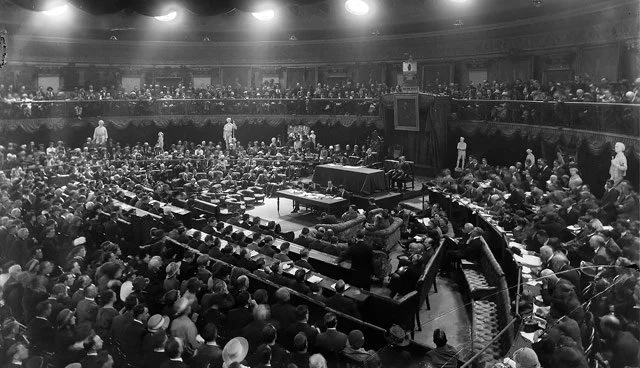
But here in the Mansion House, I recall the promise of the words of the Democratic Programme of the First Dáil:
“We declare … the right of the people of Ireland to the ownership of Ireland, and to the unfettered control of Irish destinies, to be indefeasible, and … we declare that the Nation’s sovereignty extends not only to all men and women of the Nation, but to all its material possessions, the Nation’s soil and all its resources, all the wealth and all the wealth-producing processes within the Nation, and … that all right to private property must be subordinated to the public right and welfare.”
There is major unfinished business in that promise!
Thanks to the Dublin Bohemians for putting the democratic economy back on the table in Dublin – and in Ireland.