
Geopolitics of the Iran War
An analysis of the wider significance and long-run impacts of Trump’s war of choice
April 1, 2026
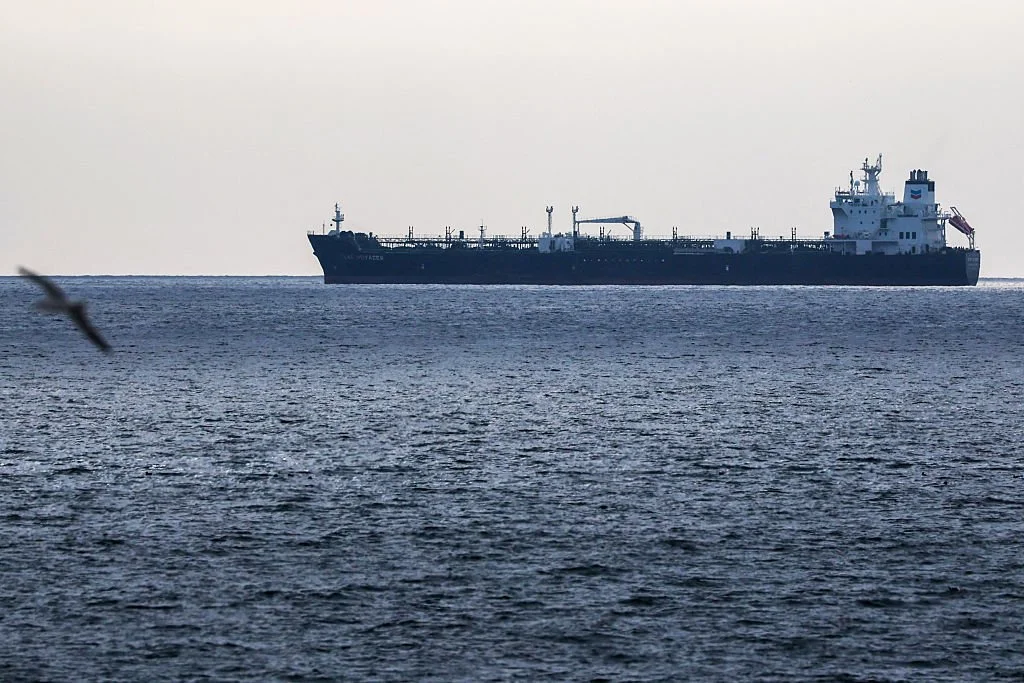
Patrick T. Fallon/Getty Images - American oil tanker in the Persian Gulf
TDC President Joe Guinan was asked to offer an analysis of the long-term ramifications of the war on Iran to a group of funders working with the People’s Network for Land & Liberation. An edited version of his remarks appears below. He was speaking in a personal capacity and the views expressed should not be attributed to The Democracy Collaborative.
I’m going to do my best to talk about the geopolitics of the Iran war, and what its wider meaning and significance might be in the short, medium, and long term – and attempt to offer an analysis. A concrete analysis of a concrete situation, as it were.
To do that, let me first make a few important disclaimers.
I am a political economist, not a military strategist, let alone an expert on the Middle East.
Any insights will necessarily be general ones, from the vantage point of someone observing from Washington, D.C., but also with a foot in Europe.
I’ve been following this war particularly closely, but I want to be clear that I am by no means an expert on Iran – although I’ve come to learn a lot about the country in the past few years.
Fog of war
One thing that makes this war difficult to comment upon is the lack of reliable information, which goes far, far beyond the usual problem of the fog of war.
On the one hand, this is the most mediatized war there has ever been. But that has been accompanied by an absolute deluge of misinformation from all quarters.
The advent of AI means we cannot trust even our own eyes and ears. Every fact, every image, every video, every statement has to be fact-checked and checked again and triple checked.
Trump himself is contributing to this, with the constant social media churn and goalpost-moving and on-again-off-again statements – about victory, invasion, mission completion, regime change, you’ve heard it all.
The legacy media in the West have been next to useless in reporting on this war. They are basically reading out Pentagon press releases.
To find out what is really happening, you have to dig online. Almost all quality geopolitical information and analysis now comes from what I’d (approvingly) term cranks, weirdos and hobbyists, and not from the established media – which retain a comparative advantage only on long reflective pieces after the fact. The former must be triple-checked, but the major media outlets are just propaganda.
“To find out what is really happening, you have to dig online. Almost all quality geopolitical information and analysis now comes from cranks, weirdos and hobbyists, and not from the established media. The former must be triple-checked, but the major media outlets are just propaganda.”
The fact is that we simply cannot believe the statements of the major protagonists — especially the United States and Israel.
Who can remember a recent war where we have no idea, literally no idea, of the scale of casualties – dead and injured – on the American side?
Or what are we to make of it when the largest U.S. aircraft carrier is pulled out of the conflict zone, for what we are now told is up to two years of repairs, and the explanation given is that there was a fire in the laundry room?
There’s also no explanation for why U.S. embassies weren’t prepared to evacuate Americans from the region. No explanation for why the war was begun without adequate supply lines or stocks of interceptor missiles. And certainly no reliable progress reports – for example, on the status of U.S. bases across the region.
To fill this information gap, to be remotely well informed as to what is happening in real time, we must seek out independent sources of information.
Open source intelligence (OSINT) however has limits in terms of the hardware available – we’ve seen the disappearance of satellite imagery of the Middle East and companies such as Planet Labs whose business model is supplying such imagery have introduced lag-times on images from the region.
We are literally not being allowed to see what is happening on the ground.
Perhaps one semi-trustworthy number we do have comes from the Iranian Red Cross and Red Crescent, who put civilian fatalities in Iran at approaching two thousand, with twenty thousand civilians injured. There are also reports of fifty thousand homes destroyed, along with hundreds of schools and hospitals.
Market manipulation and insider trading
Another complicating factor in assessing the flow of information is its suspect relationship to market movements and insider trading.
There is also obvious market manipulation and what’s known as “jawboning” at work. Flagrant insider trading and blatant war profiteering. Also efforts to use the power of the President’s bully pulpit to talk down energy prices at given points along the way.
What’s even more notable though is that there is also an evident genuine real fear in the Administration of the economic impacts of what’s happening such that markets, particularly the U.S. stock market but also commodity exchanges, are moving policy and acting as a real functional constraint on the American prosecution of this war, in a way that we haven’t seen so directly before.
“There is an evident genuine real fear in the Administration of the economic impacts of what’s happening such that markets are moving policy and acting as a real functional constraint on the American prosecution of this war, in a way we haven’t seen before.”
It literally means that actions take place on Friday nights after close of business so as to give markets the time to absorb and adjust to shocks.
The Speaker of the Iranian Parliament, Mohammad Bagher Ghalibaf, pointed this out last week such that people were able to use his intervention to predict Trump’s next statement and therefore go long or short on trades. “If they pump it, short it. If they dump it, go long,” he said. “You know the drill.”
It’s extraordinary, we’ve never seen war by instantaneous market reaction and management before, which is testament to how thoroughly the U.S. empire has been financialized.
We may see this again tonight, when Trump is due to give an address – at 9pm, after markets close – which could signal either an escalation to a ground invasion or an off-ramp.
It says something that at this perilous moment it could well be either, and most of us truly don’t have any way of knowing.
The imperial presidency has slipped the leash.
Don Tzu and The Art of War
Beneath the surface chaos, though, there is also a deeper epistemic chaos.
It is not even clear what the real aims of the war are, as the rationale keeps shifting. And it may be that it was never really determined and somewhat opportunistic.
We may never know, since this White House is not like other Administrations.
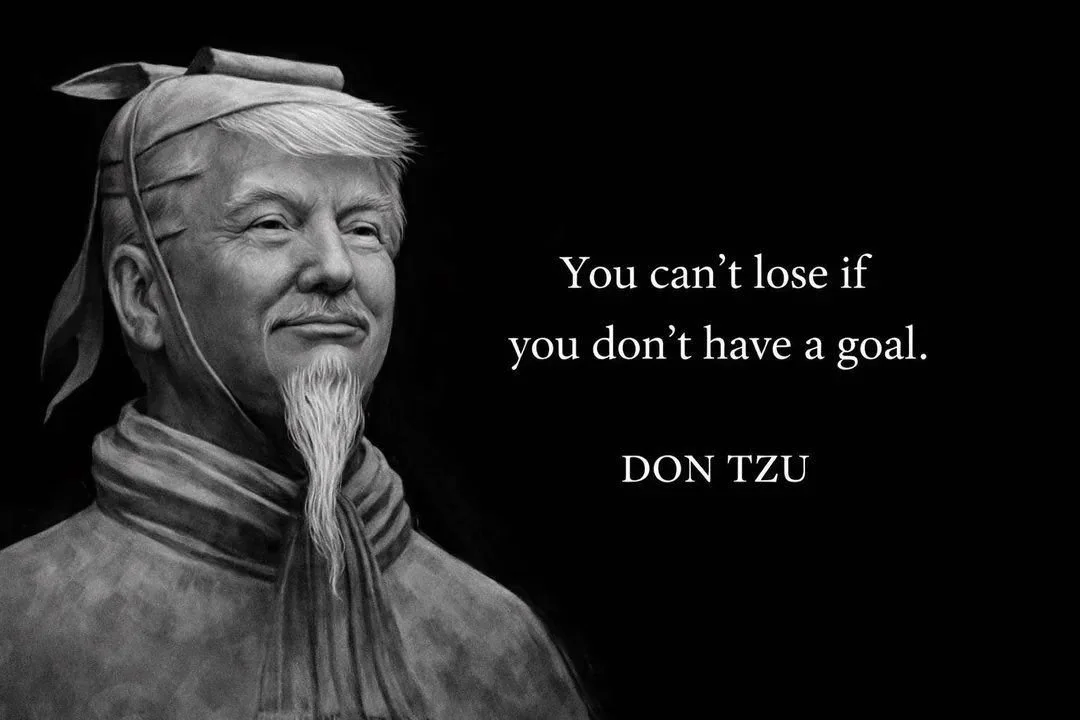
One meme has Trump as a modern day Sun Tzu, the famous military strategist from Ancient China who wrote The Art of War.
Our Don Tzu has his own aphorism: “You can’t lose if you don’t have a goal.”
On the war itself, from what we can tell, things are really not going well for Trump and Israel. Iran has surprised the world and humiliated the United States.
The early wins of the decapitation strategy were tactical and executed with the usual shock and awe. But after the dust of the early days of the war has settled, a different picture is emerging.
There is obviously an enormous asymmetry of power between the United States/Israel and Iran.
The United States is supposed to be the military superpower, the unrivalled hegemon in this area (if no longer in economic and cultural soft power).
As is well known, the United States spends as much as the next seven powers put together on its military. It has more foreign military bases around the world than all other countries put together – around 750 (or perhaps we now need to revise that down to 738).
It’s a vast military empire, and yet it is being held in check by a middle power that threatens to impose a major strategic defeat on the world’s supposed unrivaled military superpower.
“The United States is a vast military empire, and yet it is being held in check by a middle power that threatens to impose a major strategic defeat on the world’s supposed unrivaled military superpower.”
Iran is destroying some of the most expensive military hardware in the world with some of the cheapest.
Its missile capabilities seem to have evolved far beyond what the United States understood it would be facing.
It decentralized its power structure so as to be able to survive repeated decapitations to the level of five redundancies for each rank in the decision-making command, which appears to have been spread out in a “mosaic defense” type of structure across the regions.
It cannot therefore be effectively decapitated, which is clearly what Trump had in mind after successfully pursuing such a low-cost strategy in Venezuela.
The Iranians have thus been able to engage in horizontal escalation and to control the escalation game in the conflict, which is extraordinary.
But their success in surviving and fighting on militarily has been far exceeded by the success of their geopolitical strategy.
First, they have turned the U.S. military bases across the region from strategic assets to strategic liabilities, expelling the United States from effective operational use of their own bases but just as effectively turning them against the Gulf monarchies that house them.
These American allies have been left twisting in the wind as Washington has prioritized defense of Israel over the Gulf states. (Although with the exhaustion of the supply of interceptors, even the defense of Israel is now looking patchy, to say the least. I do not think we have an accurate picture of what has been happening to Israel, due to extreme censorship.)
Most impressive of all, Iran has made maximum use of one overwhelming chokepoint, of which the Strait of Hormuz has become the geographical expression, and that is the ability to disrupt the global supply of energy by blocking the movement of a fifth of the world’s oil and natural gas.
“Most impressive of all, Iran has made maximum use of one overwhelming chokepoint, of which the Strait of Hormuz has become the geographical expression, and that is the ability to disrupt the global supply of energy by blocking the movement of a fifth of the world’s oil and natural gas.”
The cascading consequences and ripple effects of this are only just beginning – not just regarding energy but fertilizer, food, transportation, manufacturing, plastics and more.
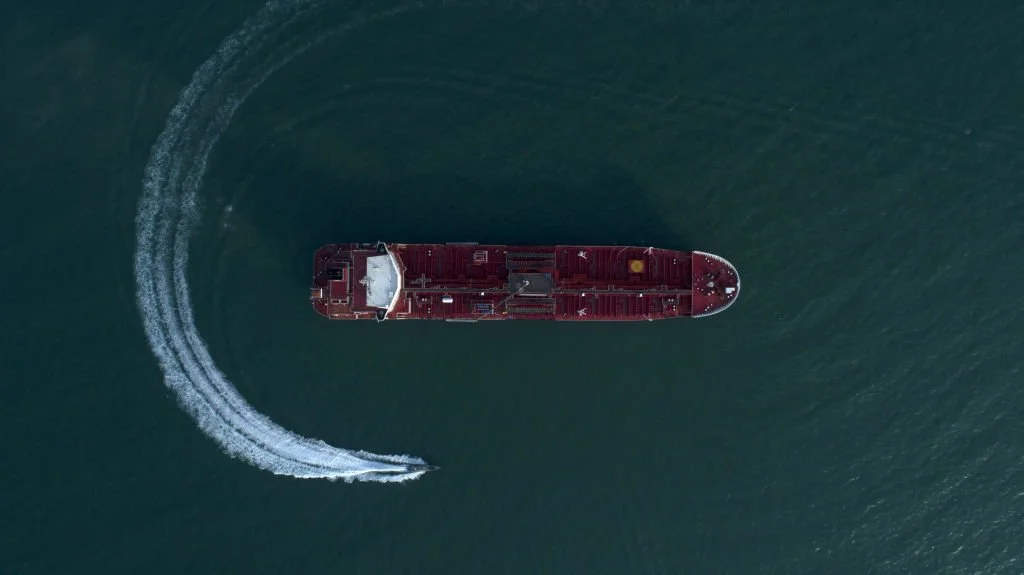
Getty Images — Iran detains British tanker
Trump’s gigantic miscalculation
I’m not usually one for underestimating Trump, which I think can be a recurring danger – falling for the clown act and missing the dangerous reptile brain beneath.
However, in this instance it does appear that he may be on the brink of a calamitous strategic defeat of a kind that the United States hasn’t really suffered since the Second World War.
Contrary to the widespread culture of bravado, the U.S. military record is not especially impressive in the postwar period, although its success in overthrowing opposing governments is much better than its track record with wars – the Jakarta Method, as Vincent Bevins has termed it. We don’t need to go into all that Cold War history.
Suffice it to say that in recent decades the United States is at least used to winning the initial military campaign — Iraq, Afghanistan — and only suffering strategic defeats as a result of attrition and guerilla resistance.
In this instance, the United States looks to be at serious risk of losing the military engagement, too – a strategic setback far greater than Suez for the British and French, or Vietnam for America.
Iran is showing itself capable of absorbing punishment but of dealing it out as well. U.S. tolerance for discomfiture, both military and economic, seems much lower, relatively speaking. Geostrategic adversaries such as China and Russia are watching carefully.
The American state has clearly been utterly hollowed out by financialization and neoliberal austerity and extraction. There is little state capacity anymore to accomplish great things: rural electrification, the Apollo program, D-Day, the Tennessee Valley Authority.
The war on Iran is exposing America as a bust. The United States spends over $1 trillion on the Pentagon budget, but they do not get value for money or bang for buck. Their aircraft carriers do not work, their missile defense systems are increasingly easily outmaneuvered, while morale in the ranks seems particularly low.
“The war on Iran is exposing America as a bust. The United States spends over $1 trillion on the Pentagon budget, but they do not get value for money. Their aircraft carriers do not work, their missile defense systems are increasingly easily outmaneuvered, morale in the ranks seems particularly low.”
Like the rest of the country, the Pentagon budget — which has still never passed an audit — is a gigantic exercise in bloated corporate welfare and pork barrel spending. The defense contractors are parasites, bleeding their host dry. As a consequence, the U.S. military is now being beaten by flying lawnmowers.
Meanwhile, the oligarchy rules, building tacky marble and gold ballrooms while the national infrastructure decays and collapses. Compare the decrepit Amtrak East Coast line to gleaming Chinese or South Korean high speed rail. Most of America now presents as a Third World country riddled with poverty and physically crumbling apart — “American carnage,” as a certain president once termed it.
The United States is not a serious superpower any more, in the sense of not being capable of serious statecraft. Trump is not of the caliber of FDR, Marshall, Cordell Hull, Kennan and the other ‘Wise Men’ of American Cold War statecraft.
Instead, we’re in the looting and pillaging stage of late American capitalism, at home and abroad.
That’s Trump’s business model – smash things, cause chaos, attempt to extract profit.
I’m beginning to understand how he managed to bankrupt his casinos!
Because this model doesn’t work in global affairs, certainly not in a time like the present, which is a time of limits and of the reassertion of vulgar material reality.
“We’re in the looting and pillaging stage of late American capitalism, at home and abroad. That’s Trump’s business model – smash things, cause chaos, attempt to extract profit.”
One way to view this conflict is a titanic struggle between financialized postmodernism and vulgar materialism — what truly matters, the society of the spectacle (and of speculation!) or the tyranny of harsh material reality on the ground?
My money is on the reassertion of the material and the return of use value over exchange value.
Which brings us to how Trump is breaking the global economy.
Definitive end of the neoliberal global economic order
The war marks the definitive end of the neoliberal global economic order.
It is no exaggeration to say that with his ill-advised war on Iran, and as a result of Iran’s entirely predictable retaliation, Trump is presently breaking the global economy.
We had already entered a period in which the breakdown of neoliberalism into post-neoliberalism was being posited – but now it is arriving with a vengeance.
Recent decades saw the intensifying weaponization of chokepoints and vulnerabilities in the global economy by the United States against adversaries. The rise of economic sanctions as a species of warfare.
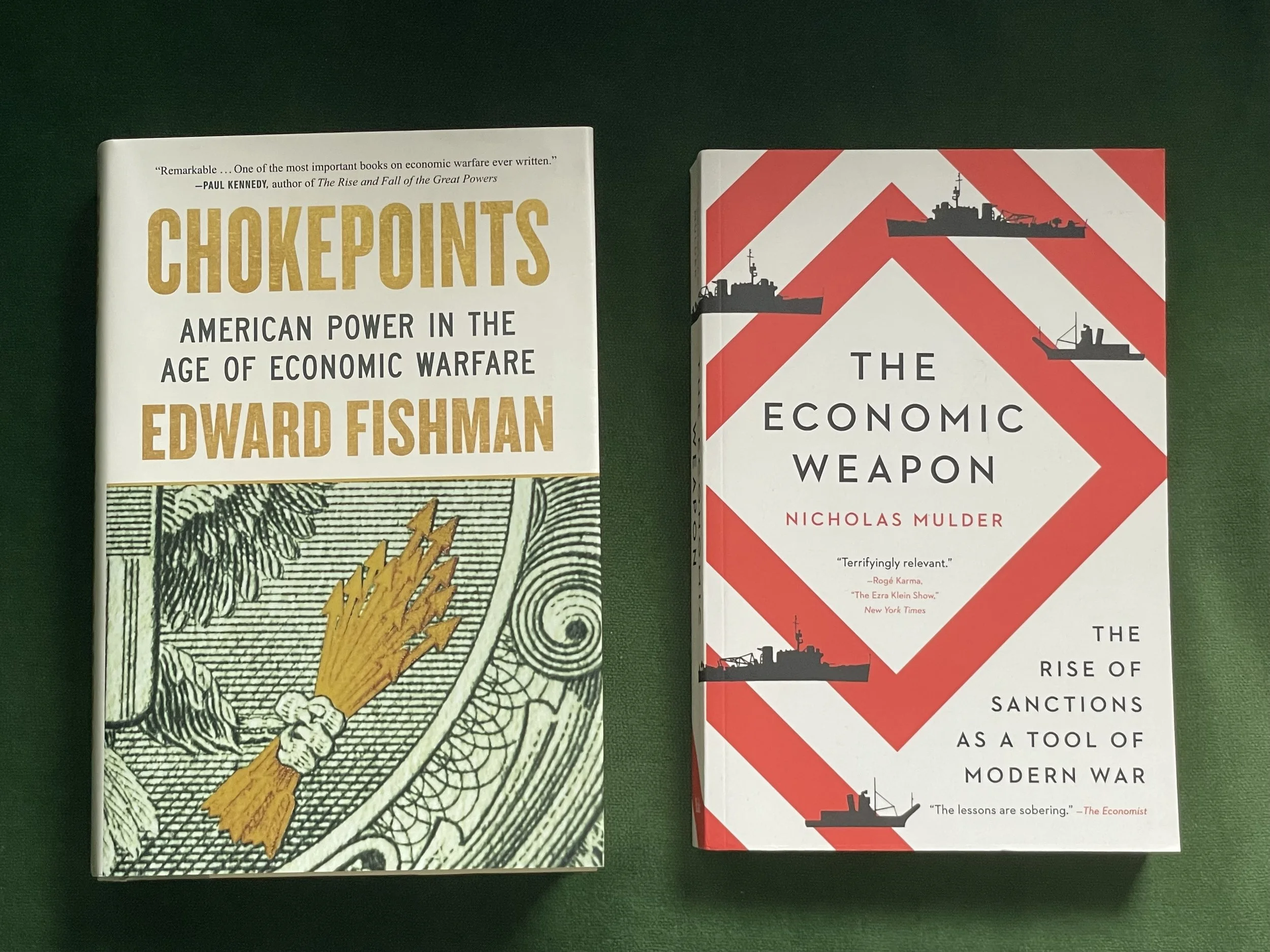
There is a whole new economics and international relations literature on this, with books such as Chokepoints by Edward Fishman and Nicholas Mulder’s The Economic Weapon.
Think of the increasingly extreme examples we’ve seen recently, with the use of economic sanctions against individuals in the United Nations or international criminal justice system.
Once they are placed on U.S. Treasury sanctions lists, these people literally cannot function internationally, as their credit cards won’t work and they can’t even maintain bank accounts or book hotel rooms or foreign travel, due to American control of international payments systems, the SWIFT system for interbank transfers, and so on.
This personalization of sanctions as individual political punishment has been wielded against Francesca Albanese at the UN and the justices at the International Criminal Court who are pursuing genocide cases against Israel and have issued arrest warrants for Netanyahu and Gallant over Gaza.
We may have arrived at a point of overreach on U.S. economic sanctions, whereby the incentives are shifting and causing those on the receiving end to begin cooperating to defeat them, establishing de-dollarized institutions and arrangements that ultimately point to the further weakening of U.S. power.
What we have seen with Iran’s control over the Strait of Hormuz is the greatest act of jujitsu in human history.
“What we have seen with Iran’s control over the Strait of Hormuz is the greatest act of jujitsu in human history… Iran has basically imposed economic sanctions on the rest of the world through their chokehold on the shipment of oil from the Persian Gulf.”
From being crippled by U.S.-imposed sanctions, Iran has turned this around such that not only has the United States partially lifted sanctions on Iranian oil as the war has progressed – Iran is currently exporting 2.4-2.8 million barrels of oil and petroleum products per day – but also lifted sanctions on Russia, while Iran has basically imposed economic sanctions on the rest of the world through their chokehold on the shipment of oil from the Persian Gulf.
We are only just at the beginning of the ripple-effects of what the International Energy Association (IEA) is already calling a global event far in excess of the OPEC oil shocks of the 1970s that led to its creation – “the greatest energy shock of all time.”
Trump has let all manner of genies out of their bottles.
Economic consequences of the war
As one observer puts it: “What appears at first as a maritime blockade is in fact the exposure of the entire global system as a hierarchy of brittle interdependencies.”
The effects spread out from maritime and shipping to finance, commodities trading, insurance, transportation, petrochemicals, fertilizer and food production, medicine, manufacturing, and much more.
It is easy to become alarmist about the fragility of globalization and of over-extended international supply chains and just-in-time production with no redundancy or elasticity, leaving us on current stocks and without resupply and with the potential onset of energy outages just mere days from food riots in major cities around the world.
But the warning signs are increasing.
The hiring numbers in America, the lowest since April 2020, show that Trump has managed to re-create the equivalent of the early COVID economy at home.
Big private credit funds like Blackrock and Apollo have already begun capping redemptions in the face of mounting withdrawal requests – you can literally only get a small percentage, 5%, of your investment capital back right now.
Here’s one solid take on what we have in store economically, from Craig Tindale on Substack, warning of what he calls “a globalised Arab Spring”:
“From this (he writes) follows a chain whose logic is cumulative: fuel inflation becomes fertilizer inflation; fertilizer inflation becomes food inflation; food inflation becomes urban instability, sovereign subsidy exhaustion, and ultimately hunger. In this sequence, food shortages are not a secondary humanitarian issue. They are one of the central political outcomes of the crisis, because modern populations do not experience systemic breakdown first through grand strategy, but through unaffordable bread, intermittent power, empty pharmacies, and possibly the collapse of public order. A globalised Arab Spring.
In this framework, hyperinflation emerges as the social expression of real physical bottlenecks. When energy-importing states are forced to acquire dollarized fuel at any price, when currencies weaken, when fertilizer and transport costs reprice an entire harvest cycle, inflation ceases to be cyclical and becomes coercive.
It enters every household budget and every state ledger at once. The result is the destruction of planning itself: firms cannot quote, governments cannot subsidize, and populations can no longer calculate the future. Under such conditions, credit markets seize up, foreign-exchange reserves drain, sovereign spreads widen, and the boundary between economic crisis and political crisis disappears.”
“It is easy to become alarmist about the fragility of globalization and of over-extended international supply chains and just-in-time production with no redundancy or elasticity, leaving us on current stocks and without resupply and with the potential onset of energy outages just mere days from food riots in major cities around the world.”
If you think this is far-fetched, here are some of the government actions that are already occurring in response to the global energy shock caused by Iran’s chokehold:
Bangladesh — imposed fuel rationing to manage acute shortages and rising prices.
Sri Lanka — introduced weekly public holidays and strict fuel quotas to cut national energy use.
India — ramping up coal-fired power generation and demand-reduction measures to offset disrupted gas supplies.
South Korea — considering energy vouchers while boosting coal and nuclear power output to stabilize supply.
Philippines — declared an energy emergency amid fuel shortages and transport disruptions.
Thailand — increasing coal use and implementing conservation policies like reduced working hours.
European Union — preparing price controls, tax cuts, and potential rollback of climate rules to cushion the shock.
United Kingdom — exploring energy price support and long-term clean energy reforms to handle inflation and supply risk.
United States — coordinating with allies on strategic reserve releases and global market stabilization efforts.
New Zealand — created an emergency ministerial task force on energy security and supply chains to manage risks.
Australia — tapping reserves while managing panic buying and domestic supply pressures.
Pakistan — facing severe fuel shortages and scrambling for supply alternatives.
Nigeria — dealing with fuel scarcity and distribution disruptions due to global supply shocks.
Vietnam — confronting shortages and supply instability linked to disrupted imports.
The mother of all Structural Adjustment Programs
Trump talks of this as if it will come and go – “short term pain for medium term gain” – but that’s what was said of the Ukraine war energy crisis, and in fact between that and COVID we have seen the onset of a new period of higher inflation and instability which looks to become part of a permanent new state of things.
Nicholas Beuret writes convincingly about this in his important recent book Or Something Worse: Why We Need to Disrupt the Climate Transition.
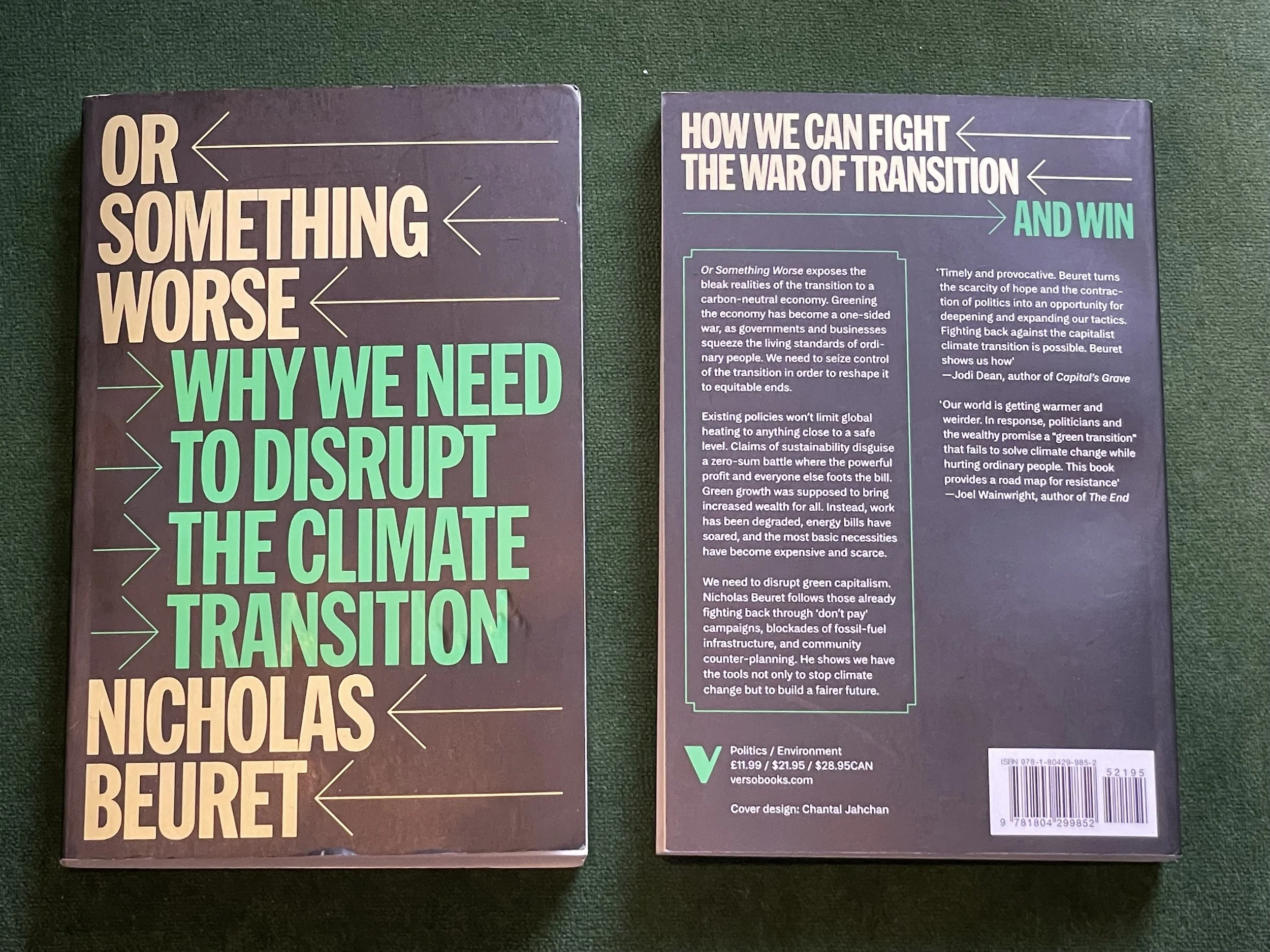
We’re entering into the period in which we begin to experience the full impacts of the climate transition. Far from a Green New Deal, it is manifesting as the Mother of all Structural Adjustment Programs, with a downward structural adjustment of living standards in the Global North and looming catastrophe in parts of the Global South.
The green transition that is occurring is both inadequate (in decarbonization) and entirely on capital’s terms. But it is more than offset by the insatiable appetite of big tech for water and energy in pursuit of techno-optimistic dreams of AI.
Incidentally, AI is among the potential casualities through the collateral damage of this war and what it will do to energy costs.
And another unintended feedback loop from this war may be the withdrawal of investment by Gulf sovereign wealth funds in the Silicon Valley big tech firms that are so much a part of Trump’s base.
Given Trump’s ire at Western European leaders, the war may also spell the beginning of the end for the NATO alliance, which would be a very welcome casualty as its disbanding is long overdue.
“Kick a hornets’ nest, as the saying goes, and it’s the hornets who get to decide when it is over.”
Kick a hornets’ nest, as the saying goes, and it’s the hornets who get to decide when it is over.
Weakness, not strength
Underneath all this a growing breakdown of the petrodollar regime and of American imperium more generally.
There’s that phrase attributed to Lenin about there being decades in which nothing happens and weeks in which decades happen.
Dedollarization of oil. The destruction of U.S. bases across the Middle East. The end of the myth of American military supremacy, even in technical terms. There has never been a more humiliating failure for American empire. Trump has speed-run decades of decline in mere weeks.
“Dedollarization of oil. The destruction of U.S. bases across the Middle East. The end of the myth of American military supremacy, even in technical terms. There has never been a more humiliating failure for American empire. Trump has speed-run decades of decline in mere weeks.”
This war is a symptom of the weakness of American empire and capital, not its strength. We are on the downslope of American hegemony. But that means that it is a moment fraught with peril.
As American economic power and cultural soft power decline, we are in a period of overhang, where all that is left to Washington is the big stick of temporary and declining military supremacy.
That supremacy is now facing a test unlike any it has seen since the Second World War in Iran. Russia and China are watching carefully, as is the rest of the Global South.
Military firepower and tactics cannot be forced to deliver strategy, much less strategic outcomes – but they are trying nonetheless.
“What was begun as an effort to arrest decline is now accelerating it. We may be witnessing American empire breaking its sword in the Middle East.”
What was begun as an effort to arrest decline is now accelerating it.
We may be witnessing American empire breaking its sword in the Middle East.
Expect trouble at home, including blowback against the left
Trump, then, looks to have made a world-historical mistake. He will be scrambling for an escape route from this catastrophic error.
We should prepare for political blowback at home, as he lashes out like a wounded beast and seeks new scapegoats for his humiliation and failure.
One of these targets may be the American left, which has been bracing for a full frontal assault by the Administration.
This is foreshadowed in Trump’s National Security Presidential Memorandum 7, a directive which threatens to use the designation of terrorism and political violence to go after a broad range of political speech and opposing viewpoints far beyond its supposed target of “Antifa.”
“We should prepare for political blowback at home, as Trump lashes out like a wounded beast and seeks new scapegoats for his humiliation and failure.”
Such a move would fit with with a fallback to a Western hemispheric strategy — Greenland, Canada, Panama, the ‘Gulf of America,’ Venezuela, Cuba — as part of a painful retreat from the punishment of his global adventurism in the Persian Gulf.
It would be in keeping with the earlier strategy of the Trump Administration across the board, which has previously attacked public sector unions and universities and has also been attacking – literally, using an armed paramilitary policy force, ICE – Democratic-run, Black-led American cities.
We are not even on the board, let alone playing to win
For all his mistakes, Trump is still in the driving seat politically in the United States. More than anyone, they have grasped the nature of the moment of crisis and responded accordingly.
Because of the total failure of the political establishment, but also our own failure to build a genuine left alternative at scale, the Trumpers have first-mover advantage, and they will continue seeking to remake the world for their own ends.
We – the left – are not even on the table politically, forced to strategize vicariously through the actions of others (Iran, China, Russia) whose geostrategic position may temporarily align with ours, but whose interests, at the end of the day, are fundamentally different and will soon diverge.
“We – the left – are not even on the table politically, forced to strategize vicariously through the actions of others (Iran, China, Russia) whose geostrategic position may temporarily align with ours, but whose interests, at the end of the day, are fundamentally different and will soon diverge.”
We are not on the board, let alone in the game, and victories and advances are unlikely to simply fall into our lap.
Creating a left worth having
We need to ask ourselves some searching questions, beginning with where is the U.S. peace movement right now?
How do we get into the game and create a left worth having?
This is a question not just in the United States but also in Europe, and in many other parts of the world.
To put it quite frankly, we have the models, the demonstration projects, the institutional innovations and designs (and of course some very old models) but we do not have the right organizational and communications and movement-building strategies.
Sometimes in my darker moments I wonder if we have the right politics – not in terms of commitments, but in terms of our relationship to the great mass of ordinary people, which is another way of saying to democracy.
It’s one thing to build some nice models and experiments at the margins, and at TDC we have done some of that ourselves. I am all for experimentation and innovation and demonstration projects.
But the moment we are in is beyond that.
We are now, whether we like it or not, in a struggle to win or lose the whole thing. And we are not yet playing to win.
There is an increasingly well-developed program of action available to us, around which we must now build alignment, purpose, focus, and popular and social power.
The game, the whole game, now lies in the construction of movements against the system capable of harnessing anti-system political energies and leading to the construction of the foundations for systemic political-economic change – that is to say, the replacement of not only capitalism but also the morbid symptoms of neofascism and techno-feudalism with our own democratic economic system at home and all around the world.
“The game, the whole game, now lies in the construction of movements against the system capable of harnessing anti-system political energies and leading to the construction of the foundations for systemic political-economic change – that is to say, the replacement of not only capitalism but also the morbid symptoms of neofascism and techno-feudalism with our own democratic economic system at home and all around the world.”
We are very far from where we need to be on this. Here in America, but also in Europe and globally.
Know your history
This was not always the case in the Middle East, within living memory.
What happened to a region that, not so very long ago, was awash with left-wing political and intellectual ferment, from Afghanistan to Palestine, as anti-colonial national liberation struggles fused with labor and peasant movements and built alliances with radical student and feminist groups?
We must learn from what happened to that left, slaughtered by authoritarian regimes imposed or propped up by ‘us’ as a bulwark against communism and in support of Zionism in the region. We should remember the tens of thousands of trade unionists, left-wing activists, students and others murdered or thrown into the prisons of Egypt, Iran, Jordan, Turkey, Iraq and Syria, whose disappearance from the political scene at ‘our’ behest left the ideological void into which extreme radical Islamism and other forces have since stepped and flourished.
“What happened to a region that, not so very long ago, was awash with left-wing political and intellectual ferment? We must learn from what happened to that left, slaughtered by authoritarian regimes imposed or propped up by ‘us’ as a bulwark against communism in the region. We should remember the tens of thousands murdered or thrown into the prisons of Egypt, Iran, Jordan, Turkey, Iraq and Syria, whose disappearance from the political scene at ‘our’ behest left the ideological void into which extreme radical Islamism and other forces have since stepped and flourished.”
We are nowhere near where we need to be in our arguments or in our political education.
And we are certainly not on the board as a force in our own right, a left seeking to unleash and command what must become a superpower of global public opinion.
Some interesting work is being done by our friends at Progressive International, including their resurrection of the conversation about building a New International Economic Order (NIEO). The model of the nonaligned movement historically is interesting.
But what we really need, as international socialists but also democrats (small d!) and radical ecologists, is a new International. An economic democracy International.
That is part of the work ahead.