
Possibility and Danger in the Age of Trump
The Decline of Neoliberalism and the Battle for Economic Democracy
March 30, 2026
TDC Vice President of Policy and Research, Thomas Hanna, was on a panel on the Trump Administration and the many crises facing the U.S. at Scotland’s Economics Festival in Edinburgh, Scotland. This piece is adapted from his remarks made on March 21, 2026.
For decades, economic policy in the United States was shaped by a relatively stable neoliberal consensus. Trade liberalization, deregulation, and the primacy of markets, private capital, and financial interests were treated less as political choices than as economic inevitabilities.
However, this consensus has started to fracture.
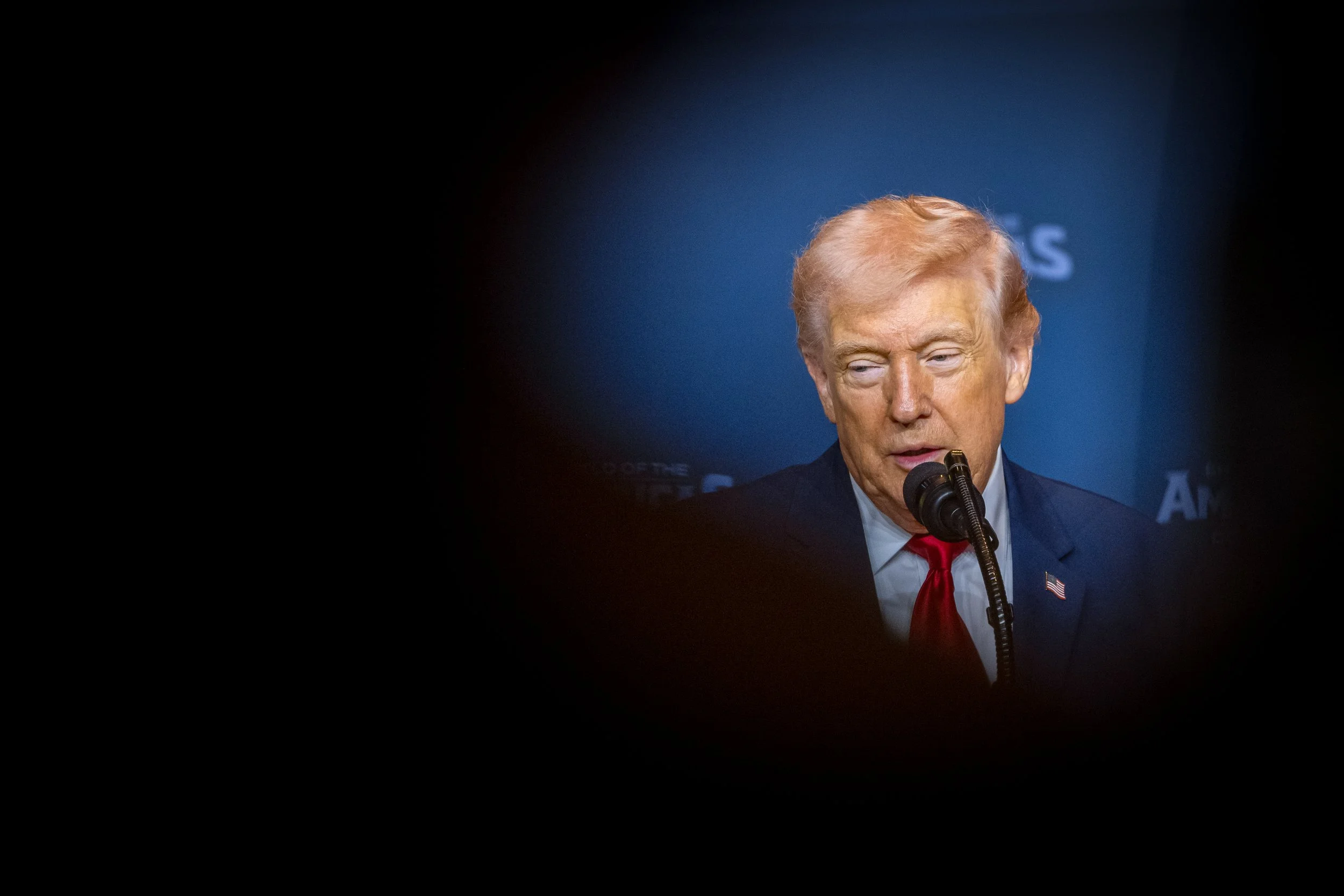
“President Trump, in particular, has broken decisively with neoliberal orthodoxy on a number of economic issues – including trade, monetary policy, and public ownership.”
Yet despite these shifts, the underlying distribution of economic and political power in the United States has changed little – and likely has only become worse. The economy continues to primarily benefit an extremely narrow set of socio-economic elites, while genuine democratic control remains elusive.
The current moment is defined by contradiction and contestation. There is a genuine opening to definitively break from the failed neoliberal past and move towards a future rooted in economic democracy, shared prosperity, and ecological sustainability. However, many of the alternative political economic ideas, approaches, and institutions necessary to do so could just as easily be used by the populist right to usher the world into a new, and violent, era of authoritarianism, parochial nationalism, and social conservatism.
The Change that Is…
Some of the most dramatic shifts in recent years have been around trade policy. “Free trade” and globalization were cornerstones of the neoliberal model; and despite mounting evidence of the negative impact these policies had on certain groups of workers (i.e. blue-collar industrial workers), communities on the periphery (i.e. former industrial hubs, rural towns, etc.), some developing economies, and the environment over the years, alternative concepts around managed trade and re-localized supply chains were often relegated to the fringes of economic policymaking.
No longer. While the luster has been coming off liberalized trade and globalization for some time (including as it related to the supply chain shocks of the COVID-19 era), President Trump’s second term has delivered a potentially fatal blow. Despite certain legal setbacks in US courts, the Trump Administration has levied a wide range of tariffs on trading partners around the world. At the time of writing, this includes a time-limited 10% tariff on imports from all countries (with some specific product exceptions) and certain industry-specific tariffs (of varying rates). This has been accompanied, and exacerbated, by the Administration’s embrace of an aggressive foreign policy based on liberally deploying both military and economic force.
These shifts in US policy have caused countries and regions to respond with their own trade-related countermeasures (e.g. Canada’s counter-tariffs). However, more fundamentally it is also forcing them to re-think their dependence on global supply chains and imports in an increasingly unstable economic and political world. This is especially true for economies that have become particularly dependent on the US as a trading partner – such as Canada and the European Union. Already, both are considering deeper economic ties with China (raising the ire of the Trump Administration even further) and are discussing ways to bolster domestic production and consumption.
A less well-known component of neoliberalism was its highly successful capture of monetary policy via ideological control of central banks. This took the form of several key tenets which became mainstream in many countries around the world, including central bank independence, a focus on fighting inflation (over other policy goals, such as full employment), and a heavy preference for (and deference to) financial interests.
“While neoliberal control of central banks has been under pressure since the Great Financial Crisis of the late 2000, President Trump has greatly accelerated it.”
In both his first and second terms, the Administration has attempted to exert control over the US Federal Reserve, especially as it relates to interest rates. In particular, the Administration has repeatedly attempted to pressure the Federal Reserve to lower interest rates, implicitly challenging its focus on reducing inflation over increasing growth or employment. Through its repeated threats to fire or replace the Chair of the Board of Governors of the Federal Reserve (most recently Jerome Powell), the Administration is also explicitly challenging the concept of central bank independence.
A third area of neoliberal orthodoxy being challenged by the Trump Administration is public ownership. Arguably, the neoliberal era saw one of the largest wealth transfers in human history as trillions of dollars of assets, enterprises, and services moved from public hands to private hands under the guise of privatization. It was often taken for granted in policymaking circles, especially in the Global North, that private ownership was inherently superior to public ownership (despite no such consensus existing in the academic literature).
While the narrative around public ownership has been shifting for years, the Trump Administration’s large-scale embrace of the concept has nonetheless surprised many experts (and dismayed adherents of neoliberalism). Since President Trump’s second inauguration in January 2025, the US government has taken an ownership position in at least 10 companies. This includes the large chip manufacturer Intel and several critical mineral mining companies. It also has agreements with other companies, including nuclear power plant operator Westinghouse and the defense contractor L3Harris, to convert investments in those companies into ownership shares under certain future conditions. And, in the case of US Steel, the US government has acquired a “golden share” as part of the company’s acquisition by the Japanese company Nippon Steel. This allows the government to veto certain business decisions, like closing or idling US facilities.
Outside of wartime (and possibly the temporary nationalizations of the Great Financial Crisis), this is likely one of the largest expansions of federal-level public ownership in modern US history. Relatedly, one of the first executive actions President Trump signed in his second term mandated the creation of a US sovereign wealth fund. If it materializes, this fund will take ownership stakes in companies and assets worldwide and become a major publicly owned economic institution.
…And the Change that Isn’t
Despite these headline-grabbing changes, the deeper structures of economic power – cemented over a half century of neoliberalism – remain largely intact. The beneficiaries of the political economic system have not meaningfully changed. There has been no discernible democratization of wealth and power to accompany these economic shifts. If anything, elite control has been entrenched during the second Trump Administration with accusations of rampant insider trading, lucrative contracts to Trump family members and political allies, the canceling of investigations into political allies and donors, and the gutting of agencies intended to regulate corruption and white collar fraud.
As it relates to tariffs and trade policy, The Trump Administration’s justifications around rebuilding productive capacity (in particular manufacturing) and protecting US workers appear to be mostly rhetorical. The most recent data suggests that while the US trade deficit has shrunk somewhat since Trump was inaugurated, domestic manufacturing as a percent of GDP has been flat (and has fallen by more than a half a percentage point since 2023). Moreover, there are no signs as of yet that any tariff revenue will be re-invested into bolstering either domestic manufacturing or wages. In other words, the Administration’s tariff and trade policy does not appear connected to any meaningful and coherent industrial strategy.

Donald Trump and Fed Chair Jerome Powell during a tour of the Federal Reserve in July 2025 | Daniel Torok
On monetary policy, the Trump Administration’s critique of the Federal Reserve is primarily centered on the bank’s failure to heed its recommendations on interest rate policy. While in practice this is a significant assault on the anti-democratic foundation of central bank independence, the Administration has not couched its criticism in the language of democratic accountability. For instance, the Administration has not, as of yet, made any proposals to restructure the Federal Reserve to end, or curtail, the influence and control of private Wall Street financial institutions. (The Fed is, famously, a relatively unique “central bank” in that it was designed by private financial interests, and these retain significant influence over its operations and policies). In fact, almost the opposite is true. In addition to its push to lower interest rates, the Administration has also been attempting to undermine the Fed’s rulemaking and supervision functions. This could make the Fed “more vulnerable to ideological pressures and Wall Street influence, and could erode the central bank's ability to safeguard the financial system,” a recent Reuters report suggests.
In short, the Trump Administration appears to be attempting to undermine central bank independence to remove the Federal Reserve as a potential counterweight to executive power and authority, on the one hand, and dismantle its already weak oversight of the private financial sector, on the other. Taken together, these efforts do not suggest movement towards a model of central banking based on genuine democratic control and accountability.
Similarly, public ownership has been pursued without public participation or control. There have been no serious efforts to use the government’s ownership share in companies to introduce democratic governance structures, expand labor rights, or align business practices with larger economic, social, or ecological goals (beyond abstract calls for resource sovereignty and national security). Moreover, even from a distributional perspective it remains unclear whether the public will benefit at all from any future financial returns, or how those proceeds might be used to lower costs, reduce taxation, or fund services.
Opportunity and Danger in Equal Measure
The Trump Administration’s social and foreign policy is undoubtedly causing untold pain in communities across the US and the world. However, this does not mean we should dismiss or ignore the importance of this political economic moment. The breakdown of neoliberal hegemony has created policy space that simply did not exist a decade or two ago. Ideas once considered peripheral — like public ownership, managed trade, democratic central banking — are now being actively implemented in one of the most powerful economies on the planet.
But this moment carries real risks.
“The Trump Administration is demonstrating that the alternative to neoliberalism is not necessarily some form of economic democracy; and that the policy levers and alternative institutions long seen as components of a more democratic and equitable economy can just as easily serve to support right-wing authoritarianism.”
At the same time, deep antipathy to the Trump Administration’s policies may lead opponents to embrace old, failed neoliberal approaches simply by reflex.
The key lesson of this moment is that the economy and its institutions have become contestable once again. The world is no longer condemned to the artificially narrow horizons of neoliberalism. But, in turn, the decline of neoliberalism does not automatically lead to a more democratic economy and society.
It merely re-opens the battlefield.