
From Gwangmyeong to Vancouver Island
November 18, 2027
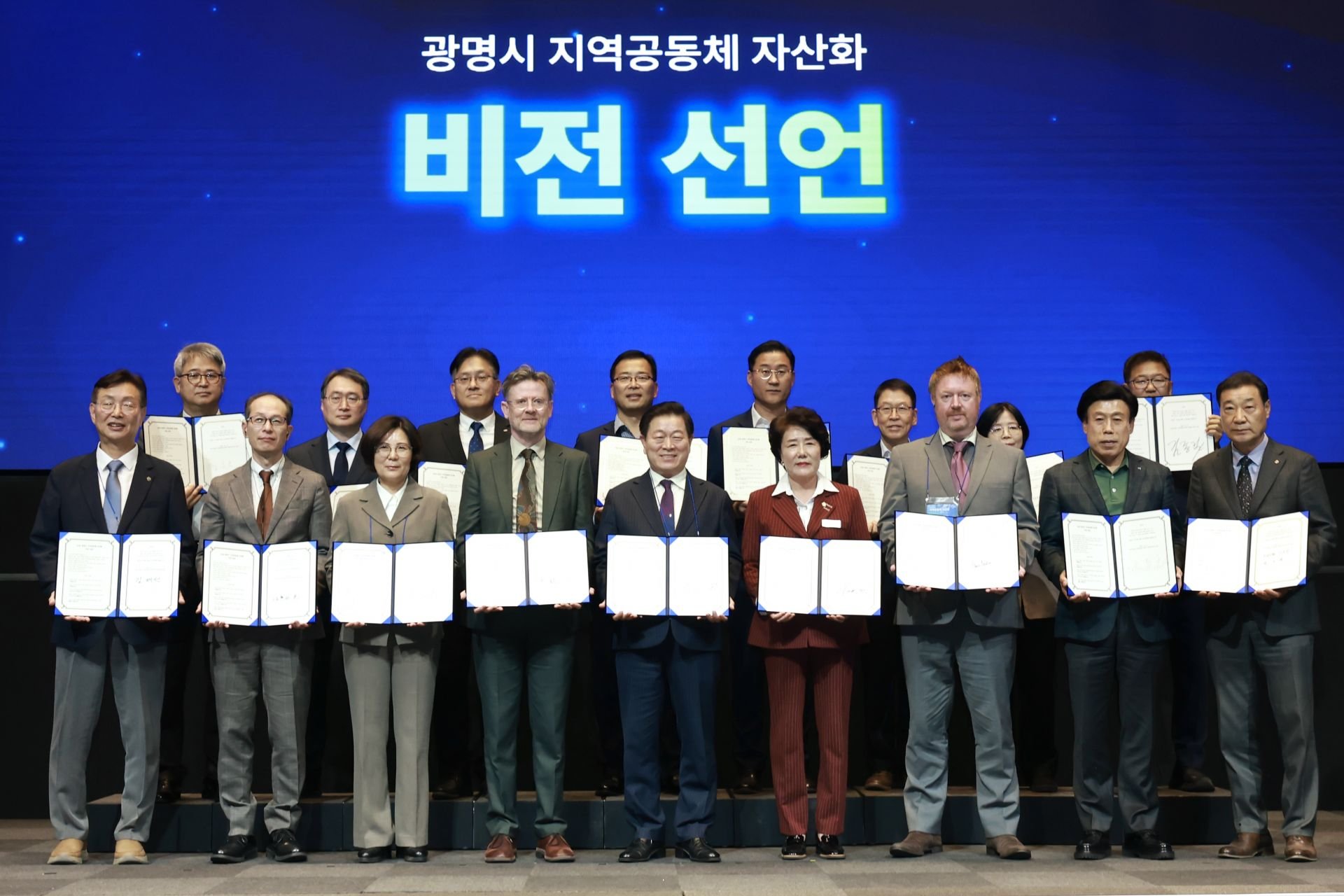
The Democracy Collaborative’s Global Lead for Community Wealth Building, Neil McInroy, returned this week from a series of trips to South Korea, Canada, the U.S., and Ireland, where he delivered various keynote talks on the growing CWB movement, visited businesses, participated in workshops, and spoke with politicians, practitioners, and policy makers. Here are some of his reflections on the things he saw and discussed along the way.
Recent visits to South Korea and Vancouver Island, Canada, have reinforced a growing conviction that I have had for many years. Not only are we in a period of unprecedented economic change, but we are witnessing a resurgence of questions of political economy as regards to economic sovereignty. And perhaps the most important of those questions is:
How much power do people, places, nations, cities or communities have to determine their economic future?
In both South Korea and Canada there is a new common understanding, whereby the assumptions that shaped recent decades have been shed, and in which globalization, ‘free’ markets, and a supposedly rules-based economic order are either breaking down or unable to respond to the crises of our times, and the realities of the 21st century.
Similar discussions are emerging elsewhere, as conveyed in our recent 20 Years of Community Wealth Building publication. In Scotland, Community Wealth Building has moved from local experimentation to national policy. In Ireland, CWB is advancing at pace. In Australia, practitioners are adapting the model to local contexts, while in the United States we are seeing a growing ecosystem of cities, anchor institutions and historically Black colleges and universities (HBCUs) exploring how economic power can be rooted more deeply in place. Although these initiatives differ in form, they are responding to a common challenge: How to build economies that are more democratic and locally accountable.
Over many decades, communities, regions and countries have seen a weakening of their capacity to shape economic outcomes, primarily due to the concentration of ownership, supremacy of shareholder value, wealth extraction and the centralization of economic decision-making. Increasingly, we have seen investment decisions which are detached from the place, people, and communities. Too often wealth generated locally is applied elsewhere. Communities are left with managing the consequence of decisions about their economy over which they have little influence.
The defining question of our time, therefore, cannot simply be how we generate economic growth and then redistribute it through the state. Instead, the central political-economic question is how wealth can be pre-distributed through ownership, governance, and control, ensuring communities, regions and nations possess the rooted economic capacity to shape their own future.
At its heart, this is a question of economic sovereignty and this requires sovereignty at multiple scales.
At the local level, communities need more control of their assets, land, and economic development. We need to see the growth of inclusive and democratic business models throughout
At the regional level, institutions require the powers and resources to both shape investment in infrastructure and industrial development according to local priorities
And at the national level, governments need the capacity and political will to pursue economic strategies that reflect democratic objectives, that look at the patterns of wealth rather than simply respond to the demands of footloose global capital
This multi-level approach is increasingly visible across the international Community Wealth Building movement.
In South Korea, the Community Wealth Building work emerging in the cities of Gwangmyeong, Anseong, Daejeon and Yeongam-gun illustrates this multi-level challenge. Each locality faces different circumstances within the nation state, but they share a common desire to expand local agency over economic development, strengthen the role of local institutions and ensure that economic activity generates broader community benefit.
Their experience reinforces the idea that Community Wealth Building is ultimately about increasing democratic control over economic resources and decisions, rather than implementing a set of technical policy tools. The most significant advances have occurred where CWB has been understood not as a collection of individual projects but as a broader framework for reshaping patterns of ownership and investment.
What made the discussions in South Korea particularly striking was how closely they echoed conversations I had a week later at the Vancouver Island Economic Summit in British Columbia. Across Vancouver Island, and Canada more broadly, communities are grappling with the same challenges experienced in South Korea. The vulnerability of integrated global supply chains, their fragile and volatile links to big neighboring nations such as U.S. and China, and how to create local determination. In Canada as in South Korea the debate is increasingly shifting towards questions of local and national ownership, resilience, regional and self-determination, and how can places participate successfully in the global economy or attain agency to shape their own futures.
Importantly, this growing focus on economic sovereignty is sometimes wrongly presented as being about isolationism or protectionism. It isn’t. In an interconnected world, international trade, investment, cooperation and solidarity remain essential.
The challenge is not whether places engage with the global economy, but on whose terms. Are they going to participate from a position of internal identity, strength and grounded agency? Or from a position where there is external dependence and, thus, vulnerability?
The Community Wealth Building approach offers a practical framework through which economic sovereignty can be pursued. Its significance extends beyond the five pillar model, beyond anchor institutions or local economic development programs. It's a bigger proposition. Economic power should be distributed more broadly so that people and places have greater control over the wealth they create. In that sense, Community Wealth Building is part of a wider movement, a movement for economic democracy, economic sovereignty, and greater democratic control over economic life.
My visits to South Korea and Canada reinforced a conviction that has become vital in this age of deep and growing crises. The debates are no longer confined to policy additions within a settled global economic frame. They are becoming part of a broad international search for new forms of economic destiny, resilience and control.
The defining challenge now and in coming decades is not just about simply generating economic growth and state redistribution, albeit ever-relevant. The challenge will be rebuilding the capacity of communities, regions, and nations, and delivering even deeper levels of collaboration. The places of the future that will succeed will not just be those who attract the most capital, they will be those that develop the institutions, the ownership models, and the democratic capabilities to develop the economy in the interests of the people, and places, and environments in which they live.
From Gwangmyeong to Vancouver Island — and on to the U.S., Scotland, Australia, and Ireland — a common lesson is emerging: Community Wealth Building matters because it offers a pathway towards a more democratic, resilient, and sovereign economy. While the pathways differ, the underlying aspiration is similar: People and places must have greater influence over the wealth they create and the economic futures they inhabit.
What is becoming visible is not simply the spread of another policy framework, but the emergence of an international movement. Community Wealth Building is increasingly serving as a practical means by which communities, regions, and nations can rediscover economic agency in an era defined by precarity, concentration of wealth/power, and the unfolding climate catastrophe.