

Last month, public banking advocates from around the United States met in Philadelphia for the Public Banking Institute’s ‘Public Banking for Public Prosperity’ conference. The event was the first national gathering of its kind for several years, and attendees heard from dozens of practitioners, activists, and researchers who are working to advance the concept and practice of public banking. TDC’s Vice President Thomas M. Hanna spoke to the gathering about the intersection of public banking and Community Wealth Building, and why The Democracy Collaborative has supported the public banking movement for more than 15 years. This post is based on those remarks.
The public banking movement is currently one of the most active and potentially transformative areas of economic democracy organizing in the U.S. Born out of the Great Recession of the late 2000s, the movement has grown tremendously in both scope and scale over the past two decades. Part of the reason is that it is an idea that is both radical in its potential, yet conventional in its application. Put another way, public banks offer the opportunity to reassert democratic control over finance and leverage local resources to create more equitable, prosperous, and sustainable local economies; and we know this is possible because there are hundreds of highly successful public banks around the world (including here in the U.S.) doing just that.
The great neoliberal experiment
The goal of The Democracy Collaborative is to help build a new political economic system in the U.S. and around the world – one that is inclusive, just, peaceful, and sustainable. Part of how we do that is through an “alternative” model of local economic development called Community Wealth Building.
For roughly 50 years, communities - and the people who live in them - have been on the front lines of a terrible economic experiment: neoliberalism. This experiment was neither a natural law nor an economic inevitability. Rather it was devised and deliberately constructed by a small group of ideologically motivated people, and the foisted on the world by their wealthy backers.
In the realm of local economic development, the neoliberal model tells communities that they need to endlessly “compete” with one another for outside (usually private), sources of capital and investment. This often means giving big subsidies and tax breaks to large corporations; reducing labor and environmental protections; selling off or cutting public assets and services; and generally giving up democratic control of local economic decision-making. It is often a mutually destructive race to the bottom where communities lose, and powerful economic elites win.
And you see the effects of it everywhere across the U.S. and the world. Neighborhoods, cities, and whole regions have been hollowed out economically and socially. Economic inequality has skyrocketed. The environment – our natural world and only home – has been severely harmed and degraded. And much of the instability we are now experiencing politically is directly attributable to the cumulative effects this model has had on people and places.
Community control of capital
Rather than asking how communities can better attract outside private investment, Community Wealth Building asks how communities can build, retain, and democratize wealth themselves. Community Wealth Building is not a standalone project or a specific singular policy intervention. Rather, it seeks to implement strategic interventions in five major areas – procurement, work, enterprises, land and housing, and finance.
“As it relates to finance, very simply put, Community Wealth Building suggests that community control of capital – and capital allocation – is critical to any effort to create a more democratic, equitable, and sustainable local economy.”
And banks are one way, although not the only way, to begin to exercise that control. Importantly, this is not just a theory. When you look at any of the more successful historical and contemporary experiments with economic democracy, they almost always include some public or collective funding mechanism.
One example is the Mondragon cooperatives in the Basque region of Spain. This is one of the world’s largest worker cooperative networks, with around 70,000 workers in 100 or so co-ops – all linked together by an overarching cooperative corporation. It also has a university, R&D centers, a mutual insurance society, and numerous non-profit organizations.
Critical to the growth and development of the Mondragon cooperatives was a credit cooperative called the Caja Laboral – now called the Laboral Kutxa after it merged with another local cooperative in 2012. This entity – which was created in 1959 – allowed workers and community members to pool their own financial resources and channel them towards developing cooperative businesses. At the time, Spain was a fascist dictatorship under the leadership of Francisco Franco. The Basque region had largely supported the democratically elected government during the Civil War, and after the fascist victory endured a concerted effort to repress their language, culture, and identity. Critically, the Caja Laboral allowed the early cooperative workers to largely bypass Spain’s large private banks – many of which backed the Franco regime – and provide support not only for cooperative development, but also cultural and social empowerment.
In addition to individual workers and residents who have accounts at the bank, the co-ops in the Mondragon network are also integrated and represented. And, like all of the Mondragon co-ops, the governance of the bank is highly democratic with various mechanisms and processes for worker and member participation and decision-making.
Throughout its history, the bank has not only helped to develop new cooperatives but has also supported existing cooperatives. This includes assisting with reconfiguring business practices and lines of work during tough economic conditions. As such, the bank plays an important role in the overall planning process that allows the Mondragon cooperatives to remain competitive in the global economy while retaining strong social and democratic values.
The Mondragon cooperatives are a good example of how a collectively owned and democratically governed financial institution can help communities assert control over capital and leverage the assets they already have to advance a form of economic development that builds and retains wealth locally. And it’s worth noting that at least partially because of the Mondragon cooperatives, the Basque region is now one of the wealthiest and most developed areas in Europe.
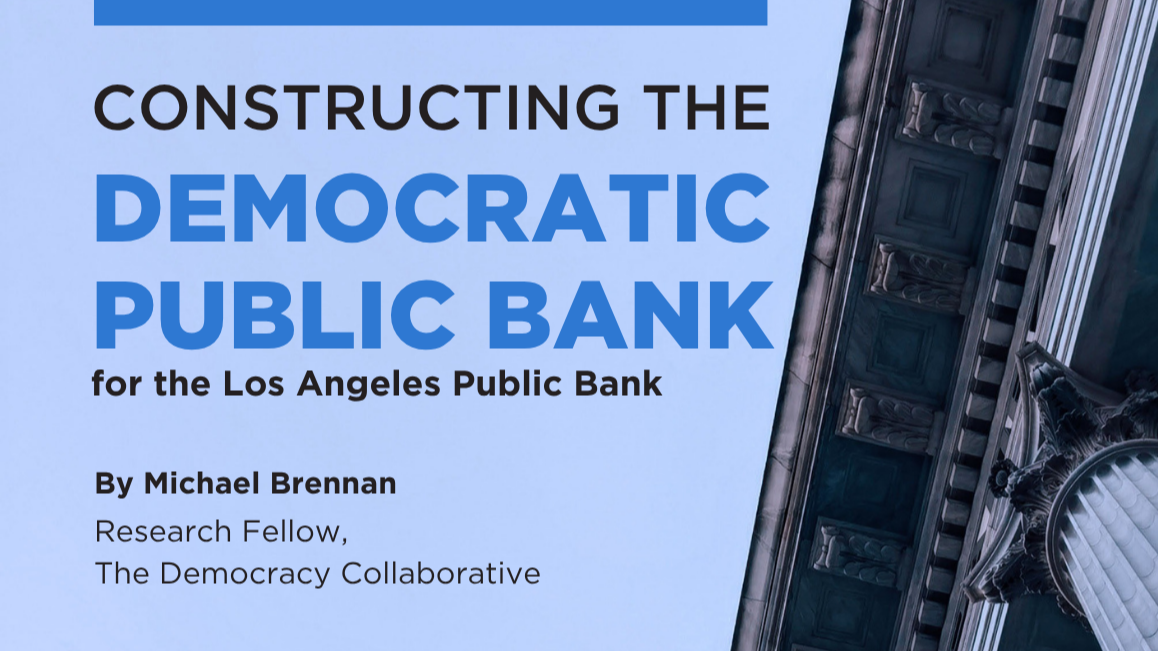
Read our 2021 report on public banking and the building of the Los Angeles Public Bank
The power of local assets
While Mondragon is undoubtedly unique for a number of reasons, and can never be identically replicated, Community Wealth Building operates from a similar basic understanding. All communities, big and small, rich and poor, have significant assets and resources at their disposal. If these were accessed, utilized, and leveraged in the right way, they could help change the economic trajectory and orientation of the local economy. More specifically, they can be used to build strong, democratic institutions and strategies that will build wealth, create jobs, and provide economic opportunities over generations.
In many ways, this is effectively the opposite of what is happening today in many communities. Not only are we not using our resources and assets innovatively and effectively, in many cases we are actually letting them be used to actively destabilize local economies.
The Great Recession of the late 2000s is an example of this. The big Wall Street banks received countless billions from local communities in the form of mortgage payments, municipal deposits, retirement investments, and so on; and then those same financial institutions almost brought down the whole world economy due to their highly speculative, risky, and often downright fraudulent practices.
The result was that millions of local people lost their homes, their retirement savings, and their jobs and businesses. Moreover, local governments watched their tax base evaporate which, along with reductions in state and federal aid, forced painful cuts to essential public services. Black communities were hit particularly hard, with median net worth dropping 53% between 2005 and 2009 – essentially wiping out decades of modest gains overnight.
Another example are financially extractive public-private partnerships (PPP) – which are sometimes called private finance initiatives in other parts of the world. During the neoliberal era, these were often used to finance the construction of critical public infrastructure – such as roads. Rather than use traditional public financing, in a PPP local governments will partner with a private entity (often connected to a large investment bank) to provide a portion of the up-front costs. The private entity will then receive the right to collect revenues from the asset for decades (sometimes up to 90 years).
“In many cases, it is well documented ahead of time that the total cost of the project under a PPP will be hundreds of millions higher than if it was done with traditional public financing. Meaning that wealth is being unnecessarily extracted from a local community for generations into the future.”
This is money people could use to buy homes, start a business, and consume from local vendors. It’s money that could be invested in additional infrastructure improvements in the future. Instead, it is flowing into a large private financial institution (and ultimately into the pockets of their wealthy investors), year in and year out.
Moreover, in some cases these PPP deals explicitly relinquish democratic control over local decision-making. For instance, some include clauses that will prevent local governments from building additional new infrastructure (such as another road) that might compete with the extractive one. And others contain clauses that require the public to pay additional sums to the private entity if revenue and usage projections fall short of forecasts.
Public banks and Community Wealth Building
Finance is one of the five key pillars of Community Wealth Building, and many Community Wealth Building projects around the world include some collective funding mechanism. For instance, the Evergreen Cooperatives in Cleveland, Ohio – which is loosely based on the Mondragon model – includes a “Fund for Employee Ownership.” This multi-million-dollar revolving loan fund is embedded in the cooperative corporation and is used to convert local businesses to worker ownership and bring them into the Evergreen network. In Preston, England, there is an ongoing effort to create a regional cooperative bank and integrate it into the larger Community Wealth Building project already underway in the city and the wider Lancashire region.
As important and valuable as these experiments are, they are relatively small-scale efforts. Public banks offer the potential to greatly expand the impact and effect of community control of capital. More specifically, public banks allow a local community to retain and leverage its collective financial resources (not just a portion) for long-term economic and social benefit.
The publicly owned Bank of North Dakota provides a powerful example of how this occurs. The state deposits all its revenue in the nearly 110 year old bank, where it is then leveraged to make loans and investments (in partnership with local banks and credit unions) in several areas, including disaster relief, business development, and education (e.g. low-cost student loans). The bank also provides services for local banks (helping the state preserve a rich and diverse local banking ecosystem), manages various state revolving loan funds, and can adjust its focus areas to meet changes in state needs and priorities (such as creating home lending programs when the housing market is stressed).
Each year, the bank also returns hundreds of millions to the state’s general fund that can be used for social services and other policymaker priorities. In 2025, the bank had $10.7 billion in assets, a loan portfolio of $6.1 billion, net income of $231.8 million, and returned $353.3 million to the state.
“Public banks are not inherently good or bad. Their greatest power is that they are contestable and constructable institutions that can, if designed properly, reflect the needs and priorities of the local community.”
As engines of Community Wealth Building, public banks could provide funding to worker cooperatives (like in Mondragon), ESOPs (another form of worker ownership), community land trusts and other cooperative housing models, social enterprises and community-based non-profits, community development corporations, and so on. Moreover, like with the Bank of North Dakota, they could (and should) do so in partnership with local financial institutions such as credit unions, CDFIs (community development financial institution), and community banks.
Public banks should also be designed to maximize democratic participation and accountability, while ensuring professional management and minimizing politicization. This could include a variety of direct and indirect governance and accountability structures, including appointments from executive of legislative bodies, citizen assemblies, multi-stakeholder boards, autonomous resident “observatories,” works councils, and many other mechanisms that have been tried and tested in democratic institutions around the world.
The future is public (banking)
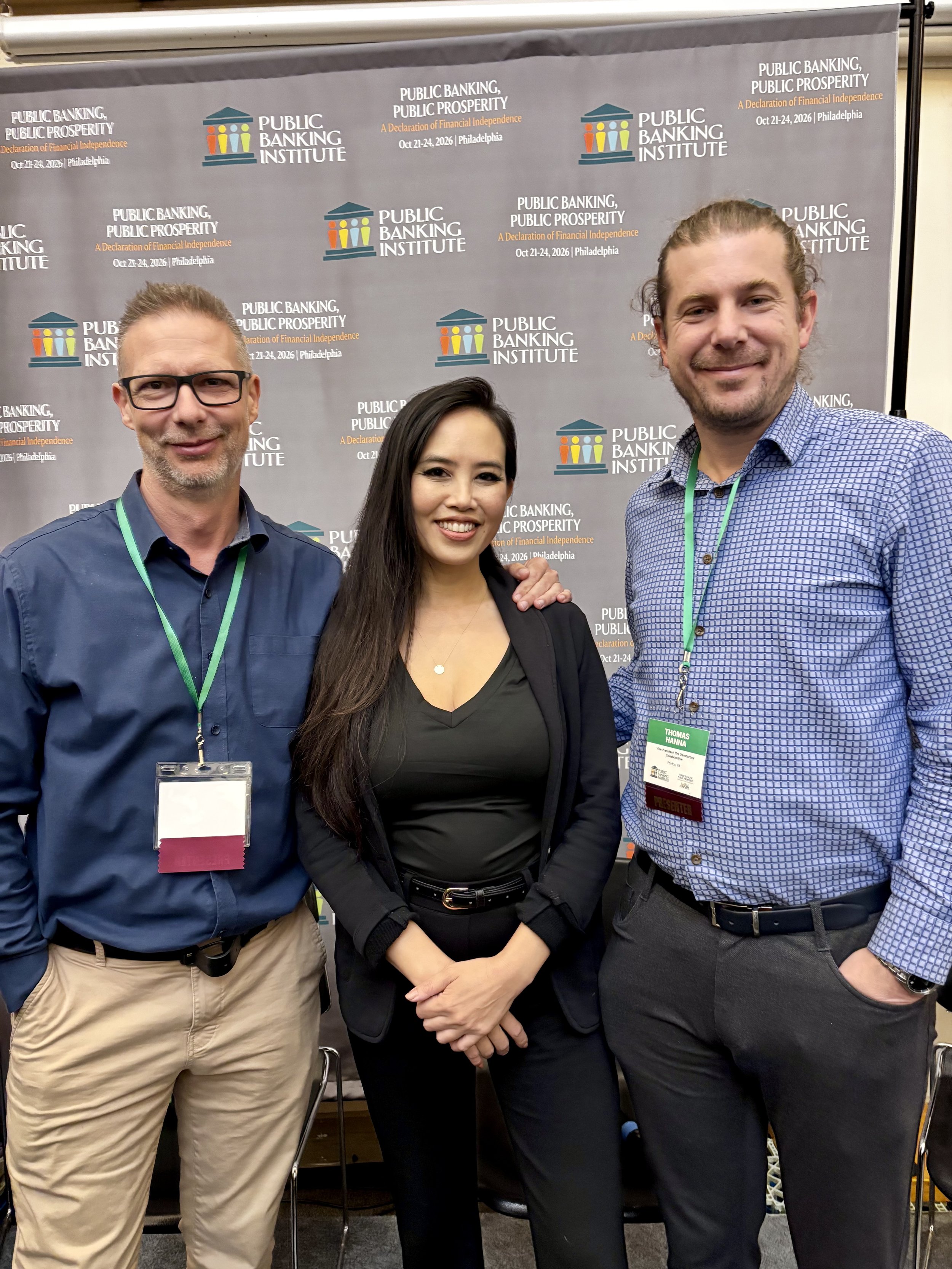
L-R: Thomas Marois, Director, Public Banking Project; Trinity Tran, Executive Director, Public Bank Los Angeles; and Thomas M. Hanna, VP of Research & Policy, The Democracy Collaborative
While the emergence of new public banks is the coming period is far from guaranteed – the opposition from private Wall Street banks is fierce and well-funded – public banking in the United States is an idea whose time may have finally come. Recently, Los Angeles – the second largest city in the U.S. – approved funding for a public bank feasibility study; and San Francisco and Berkely have public bank measures on the ballot for the November 2026 election. On the other side of the country, New York City Mayor Zohran Mamdani has been a long-time supporter of public banking, having co-sponsored the New York Public Banking Act as an Assemblyman in 2021-22. Moreover, the concept is supported by a wide array of community, labor, and social justice organizations in the city.
Even if these efforts fail or stall in the short term, to paraphrase Martin Luther King, Jr, “the arc of history is bending.” As the neoliberal model of economic development continues to falter and mutate – and as communities across the US and the world confront widening inequality, economic and political instability, and the accelerating impacts of climate change – the need for alternatives is becoming both more pressing, and more viable. Public banks have the potential to become one of the most important institutional tools within a broader political economic transformation rooted in Community Wealth Building and economic democracy.
By reclaiming democratic control over capital and aligning financial resources with public purpose, they can help communities direct investment toward long-term social, economic, and environmental goals, and the democratic and collective institutions that can deliver them. Rather than allowing local resources to be extracted and increasingly concentrated in the hands of billionaires and Wall Street financial corporations, public banks can ensure that community resources are reinvested in affordable housing, worker ownership, small business development, sustainable infrastructure, education, and other foundations of broad-based prosperity.
Public banking, integrated within a broader Community Wealth Building framework, offers a tangible opportunity to build economies that are more democratic, equitable, resilient, and sustainable. It is a chance to transform finance from an extractive force into a public asset that serves communities for generations to come.