
A Legacy City at a Crossroads
December 5, 2025

As the United States’ economy faces emerging new shocks and challenges – from pandemics and trade shocks to the job-killing effects of Artificial Intelligence, automation, and robotics – the conditions long faced by rustbelt communities may be in the process of being generalized to the national economy, giving the economic strategies pioneered there a wider potential application. In this first blog, TDC Community Wealth Building Fellow Abimael Chavez-Hernandez, in residence with WEPOWER in St. Louis, shares some initial reflections on the challenges of building the democratic economy there.
In many ways St. Louis, with a population of 280,000 in 2024, is experiencing many of the same challenges as other “legacy cities” in the United States. St. Louis has experienced significant population decline, loss of its industrial manufacturing base, and decreased property values, which make it harder to collect sufficient tax revenues to make new and sustained investments in public infrastructure. But the city also faces particular challenges in the extent of population decline, municipal fragmentation in the neighboring county, and extreme and persistent residential segregation, which has directly contributed to the region’s slow population growth.

As a Community Wealth Building fellow with WEPOWER and the Democracy Collaborative, I have been able to learn about these challenges up close and to witness the complex nature of the solutions currently being considered as remedies. In this role, I have found a number of key aspects of the region to be crucial to understanding the policy context and the potential to implement Community Wealth Building strategies here.
These aspects are examined below, and this is the first of a series of blogs on the ongoing roll-out of CWB in St. Louis.
Losing People: Major Population Shifts
At its peak, in 1950, St. Louis was home to 850,000 residents.
With just under 280,000 residents today, this represents a loss of fully two-thirds of the population in the past 75 years, putting the city in a similar population decline context to that of Detroit. For comparison, the city of Pittsburgh, Pennsylvania – often considered a peer city – experienced an approximately 55 percent population decline over the same period. Unlike St. Louis, however, Pittsburgh’s population has been increasing in recent years.
At the regional level, growth has been low despite the increasing population of neighboring St. Louis County. Were the region to grow at the rate of metropolitan areas nationally, the region would be home to 4.2 million residents rather than the current population of 2.8 million, a 50 percent increase.
The Challenges of Regional Governance
The region today is anchored by the city of St. Louis and neighboring St. Louis County, which contains 88 municipalities. This division has its origins in what is often referred to as the “Great Divorce” in which the city of St. Louis separated from the county in 1876 to gain more autonomy over its tax revenues and service management. Until the 1950s, this separation proved advantageous to the city as its population grew and it remained home to a robust economic base composed of some of the country’s most profitable corporations.
But with the post-World War II suburbanization of the region in the 1950s, the city reached its peak population and a decades-long population decline began which continues to this day. This suburbanization facilitated white and middle-class flight into the county’s growing number of municipalities that had begun incorporating during that decade. Many of these communities were incorporated as a deliberate way to resist racial integration and to avoid paying the bills for racial justice, urban regeneration, and social progress.
Persistent Wealth Disparities
Due to a legacy of exclusionary policies in housing, transportation, and business development, the St. Louis region is home to some significant racialized wealth disparities, which are a pronounced feature of the U.S. economy as a whole. For example, while 56.7 percent of white St. Louisans own their homes, the same is true for only 33.2 percent of Black St. Louisans., depriving the latter of the principal means of wealth accumulation in an era characterized by long-running wage stagnation.
Neighborhoods such as Mill Creek Valley, a historic Black neighborhood in the city’s center, were demolished in the 1950s for the construction of Interstate 64 (I-64). This development meant 20,000 residents, most of them Black, 800 businesses, and 40 churches were destroyed. Displaced residents were often provided with little to no compensation for this loss, and many former residents moved to the north of the city, which further entrenched racial segregation in the city and the region as a whole.
Ongoing Racial Segregation
Decades of discriminatory policies in housing, education, and transportation have led to St. Louis city and the region being one of the most racially segregated cities in the country. This legacy has culminated in what’s referred to as the “Delmar Divide,” in which the northern half of the city is predominantly Black while the south of the city is overwhelmingly white. Combined with the cumulative impact of past exclusion from housing wealth and employment opportunities, this has resulted in significant disparities.
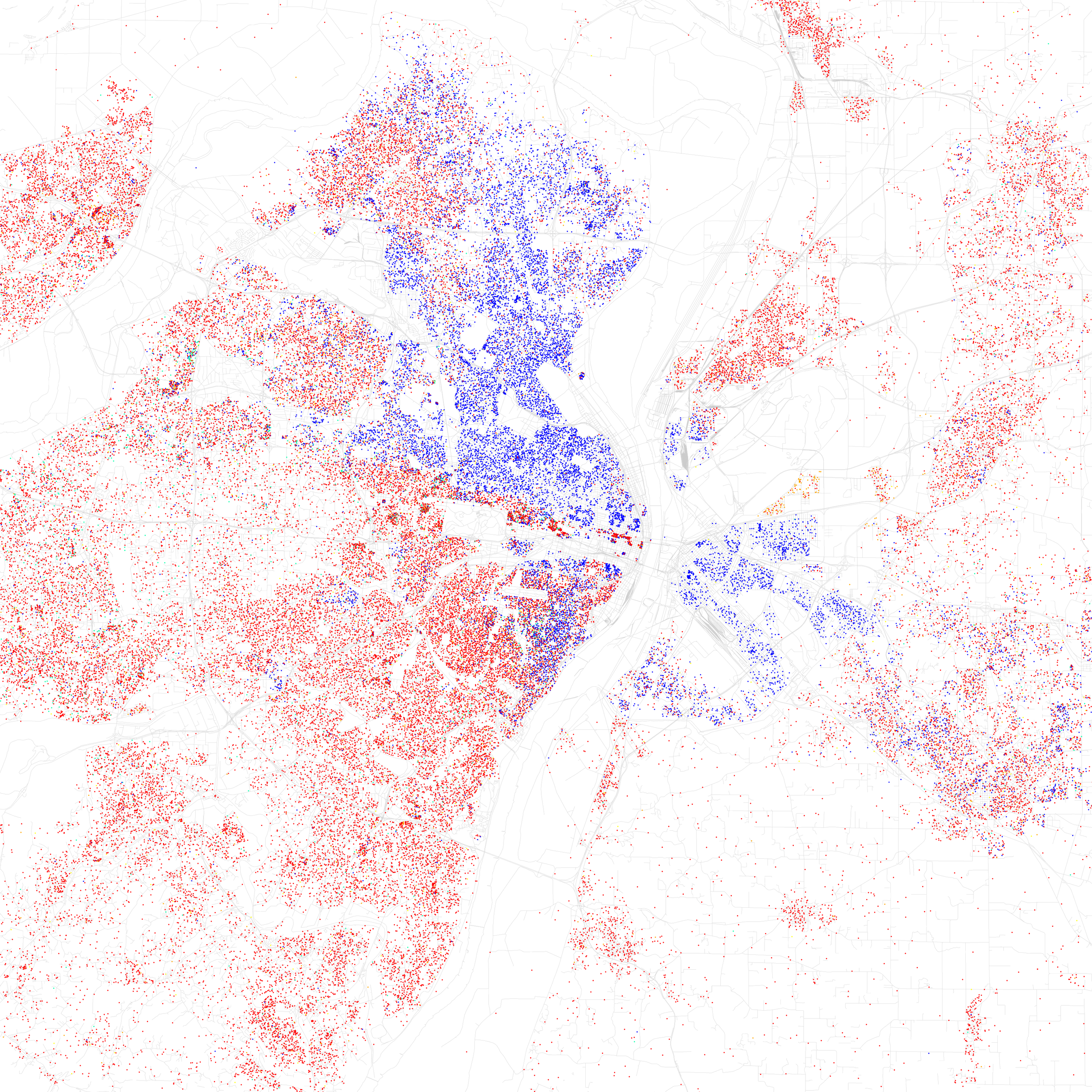
Race and ethnicity 2010: St. Louis
Red is White, Blue is Black, Green is Asian, Orange is Hispanic, Yellow is Other, and each dot is 25 residents.
Data from Census 2010. Base map © OpenStreetMap. Image by Erica Fischer
In one analysis the poverty rate was found to be 32 percent in North St. Louis, while it is only 10.7 percent in the region overall. And as the region has failed to build sufficient housing at all levels of income, this has often resulted in few opportunities for residents to take advantage of economic opportunities in other parts of the area. Consequently, racialized residential patterns persist and those seeking broadened economic opportunities often leave the region altogether.
At the state level, the policy environment has either been discouraging of, or has outright preempted, efforts to enact policies which could improve working conditions and reduce racial wealth disparities. For example, in November of 2024, voters statewide approved Proposition A to provide workers up to eight days of paid sick leave and an increase to the state’s minimum wage with indexing to inflation beginning in 2027. In July of 2025, the state legislature repealed this law with House Bill 567 to end implementation of Proposition A on August 28, 2025.
Bottom-Up Local Action
Given this context, advocates have shifted their focus to local policymaking, where they face potentially more hospitable policy climates with more legislative champions. Municipal and regional level policymaking in St. Louis are also potentially more fertile ground for adopting Community Wealth Building strategies as local leaders are more receptive to the need for regional solutions rooted in the area’s history to stem the loss of population and economic growth.
As many of the challenges afflicting legacy cities begin to take shape in new shocks and disruptions to the U.S. economy as a whole – such as reduced spending power due to the cost of living crisis, trade shocks, and the ongoing impacts of automation and Artificial Intelligence – the strategies being developed here in response to decades of disinvestment, deindustrialialization, and displacement may quickly begin to have a greater application far and wide beyond their rust-belt origins in places like St. Louis.