Happy Holidays Everyone!
Hello again!
We hope you have been enjoying the CWB-COP newsletter so far. We know delivery has been a little patchy, but that is due to change as we plan to expand and perfect it in the coming year. So watch this space.
In this final CWB-COP Newsletter of 2025, the whole team at The Democracy Collaborative would like to take this opportunity to wish our supporters, subscribers, friends and collaborators a very merry holiday season and a great start to the New Year.
Please be sure to save us in your email contacts so these emails don’t end up in your spam folder.
Child care is an important part of supporting workers in St. Louis
WEPOWER and HOSTL teamed up to amplify the stories of educators and families who are part of the childcare community.
Families with children aged zero to five navigate a system starting at birth that is complex, expensive, and inaccessible. Childcare providers and workers are on the frontlines no matter what — during COVID, during the tornado, and catastrophe after catastrophe — so parents can go to work, provide for their families, and keep our economy running.
There’s a saying: ‘Childcare keeps Missouri working.’
It’s true. You can’t work without it. Childcare matters because it impacts not just the children, but families, neighborhoods, and the economy. COVID reminded us that we need childcare for people to go to work. If a childcare center isn’t open and operational in an underserved area, a mom can’t work. If she misses work, she might lose her job. If she loses her job, she can’t afford her car. All the way the cycle goes potentially ending in homelessness.
Read more about the initiative here.
Building the Next System in a dangerous interregnum
We live in Gramsci’s “time of monsters”.
And we continue to monitor with growing alarm the political assaults unfolding across a broad front in the United States.
Following attacks on immigrant communities, public sector workers and unions, universities, and U.S. cities, the latest target is civil society, singled out in a White House executive order issued on September 25.
TDC is a signatory to an open letter from nearly 4,000 nonprofit organizations opposing this dangerous executive overreach, which points to a radical redefinition of the powers of the state over civil society as part of a growing authoritarianism now threatening the fundamentals of democracy, speech, and political freedom in America.
Our Tracking the Crisis informational news roundup continues to summarize unfolding developments on a week-to-week basis.
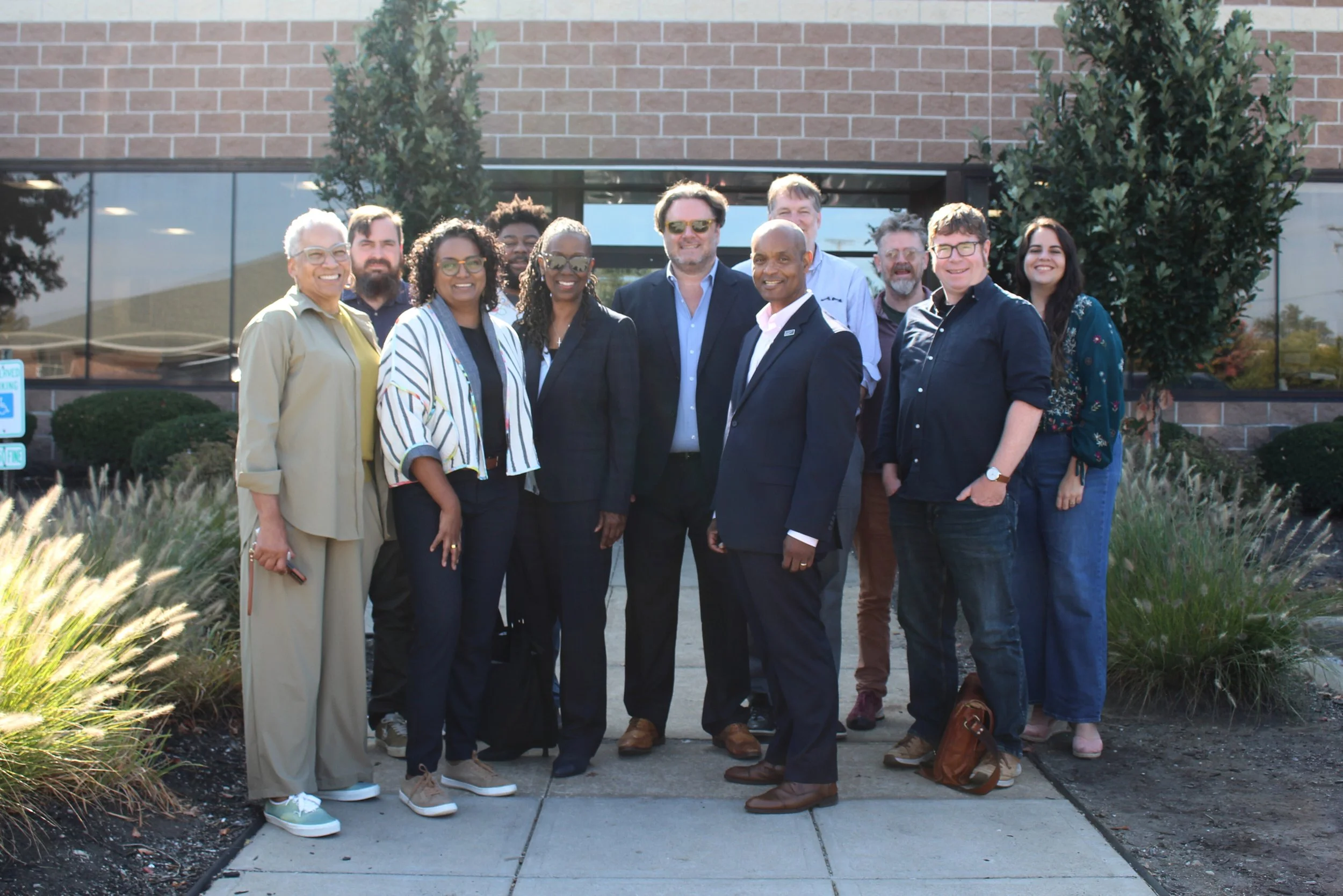
Against this darkening backdrop, TDC’s team and board gathered in September in Cleveland, Ohio for our annual in-person staff retreat and quarterly meeting of our board of trustees.
Among the questions on the table for us an an organization were the nature of the shifting opportunities and challenges of the present moment for advancing Community Wealth Building and Next System thinking, and the role of municipal and state-level democratic economy strategies and approaches in filling the fiscal space left by federal cutbacks and the top-down political assault on the administrative and regulatory state.
In particular, we explored the application of Community Wealth Building models and strategies for a bottom-up attempt to close the racial wealth gap in America.
While in Cleveland, we were able to check in on local Community Wealth Building projects old and new.
We were welcomed into town for an evening of entertainment by our partners at Leo’s Casino Arts and Music Collaboratory, who are seeking to help unleash a community-driven revitalization of parts of the Hough neighborhood in Midtown using Cleveland’s rich and storied history of popular music to build community ownership in the cultural industries.
We were also able to visit our old friends at the Evergreen Cooperatives, with a guided tour of the impressively massive Evergreen Cooperative Laundry site in the Collinwood neighborhood, where they service the needs of their partners at the Cleveland Clinic whilst building cooperative worker ownership and community wealth.
It was instructive to learn about the many ways in which the worker cooperative is better able to meet the requirements of a large-scale health system than was the multinational company that previously held the contract, as well as to witness the many environmental and ergonomic improvements they have already put in place at the facility.
There are obvious applications of the Evergreen model to the whole sector of anchor institution-serving laundry services, requiring only the mission-oriented capital for which so many new economy innovations are hungry.
At the point at which the country is prepared to break with systemic crisis and our present downward course, there are readily-available Community Wealth Building alternatives that would allow us to structure our economy in ways that meet the needs of the vast majority without leading to the plutocratic takeover of our politics by a fascist-supporting billionaire class.
Scotland: Legislative Leadership on Community Wealth Building
Scotland continues to lead globally in institutionalizing CWB.
The Community Wealth Building (Scotland) Bill, introduced in March 2025, is currently at Stage 1 in the Scottish Parliament. If passed, it will become the world’s first national legislation dedicated to Community Wealth Building.
The Bill aims to embed a new economic model focused on local democratic control, inclusive ownership, and fair distribution of wealth. And it seeks to empower public bodies to advance CWB through statutory duties and strategic planning.
As part of the legislative scrutiny process, the fair work and economy committee of the Scottish Parliament published its findings. The Committee supported the general principles of reshape Scotland’s economy toward greater equity and resilience. It specifically asked that the legislation provided a clearer definition of CWB and its core principles to ensure consistent interpretation and implementation across sectors and a call for robust monitoring frameworks and clearer lines of accountability to assess progress and impact.
The Committee also highlighted that success will depend on the strength of the accompanying statement by Scottish ministers that clearly sets out the intended policy outcomes, and the provision of clear and consistent Scottish government guidance that helps CWB partnerships to produce action plans.
New Publications
Community Enterprise in Scotland, in partnership with Creative Scotland has launched a Community Wealth Building (CWB) Toolkit for the Arts, Culture and Creative Industries.
The CWB Toolkit is a comprehensive, interactive resource that
Explains the five pillars of Community Wealth Building in an accessible and sector-relevant way
Offers practical guidance, case studies, and self-assessment tool
Highlights the economic, social, and cultural value of the creative industries in Scotland
Advocates for the inclusion of arts and culture in local CWB planning and partnerships
Upcoming Events
Virtual Training: Introduction to Community Wealth Building
Wednesday, December 10 - 10am PST | 1pm EST | 6pm GMT
Be part of the next newsletter!
Please share what is going on in your neck of the woods.
You can easily drop us an email by clicking the button below.